Cart

Your cart is empty

Continue shopping

Popular searches

Featured products

Hormonal Base
Sale price€65,00
(5.0)
Midlife balance
Sale price€75,00
(5.0)
Ernährung in den Wechseljahren: Was wirklich hilft
WechseljahreMar 12, 202511 min read

Menopause Nutrition: What Really Helps

This article is part of: Menopause & Perimenopause: The Complete Medical Guide

Menopause changes metabolism, body composition, and nutritional needs. What diet truly fits according to current studies and what an everyday life that works looks like.

Key takeaways

The Mediterranean plant-based diet is the best-evidenced nutritional basis (EMAS 2020). Protein intake should be 1.0 to 1.2 g per kg body weight, distributed over three meals with 25 to 30 g each. Calcium, vitamin D, and at least 30 g of fiber per day (DGE) should be prioritized. Reduce alcohol and highly processed foods.

Why diet should change during menopause

With the decline in estrogen, body composition changes: muscle mass is built more slowly, fat is more frequently deposited centrally, insulin sensitivity decreases, and the risk of osteoporosis and cardiovascular disease increases. At the same time, energy requirements decrease by an estimated 200 to 400 kilocalories per day, but the need for protein, calcium, and some micronutrients remains high.

The practical consequence: fewer calories, but more nutrient density per bite. Our medical guide to perimenopause and menopause explains the exact hormonal phases behind this; for an overview of the most common symptoms, see Is this menopause? The 10 most common symptoms.

Which diet is best supported by evidence during menopause?

The best-researched nutritional basis is the Mediterranean diet. The European Menopause and Andropause Society classified it in its 2020 position statement as the most evidence-based diet for the menopausal phase, associating it with positive effects on hot flashes, blood pressure, cholesterol, mood, bone density, and cardiovascular risk.

Mediterranean in practice

What counts, what is rather rare

The Mediterranean diet is not a diet plan, but a pattern. These three groups will help you navigate your daily life.

Plenty of

  • Vegetables and salads
  • Fruits (especially berries)
  • Whole grain products
  • Legumes
  • Nuts and seeds
  • Olive oil as the main fat source

Regularly in moderation

  • Fish 1 to 2 times per week
  • Eggs
  • Yogurt and quark
  • Poultry
  • Cheese in moderate amounts

Rather rarely

  • Red and processed meat
  • Pastries and sweets
  • Sugary drinks
  • Highly processed convenience foods
  • Alcohol

In the Australian longitudinal study ALSWH (Herber-Gast and Mishra 2013, around 6,000 women), high adherence to the Mediterranean diet was associated with an approximately 20 percent lower risk of hot flashes and night sweats. Observational data, not a causal study, but consistent with further cohorts.

How much protein do you really need, and why distribution matters

The short answer: about 1.0 to 1.2 grams of protein per kilogram of body weight per day, spread across three meals with about 25 to 30 grams of high-quality protein each. The German Nutrition Society recommends at least 0.8 grams per kilogram for adults and 1.0 gram from age 65; international expert groups PROT-AGE and ESCEO recommend 1.0 to 1.2 grams for women from perimenopause onwards.

For a 65-kilogram woman, this means 65 to 80 grams of protein per day. The distribution is important: according to Layman 2024 (Frontiers in Nutrition), women from about 60 years of age only achieve maximum muscle protein synthesis when a meal contains about 2.8 grams of leucine, which corresponds to about 25 to 30 grams of high-quality protein. Breakfast is often the weak point here.

Good protein sources include skyr and quark, eggs, fatty fish, legumes, tofu and tempeh, lean poultry, and nuts and seeds. If you want to delve deeper into protein because weight gain during menopause is an issue, you will find a detailed classification of body composition and strength training there.
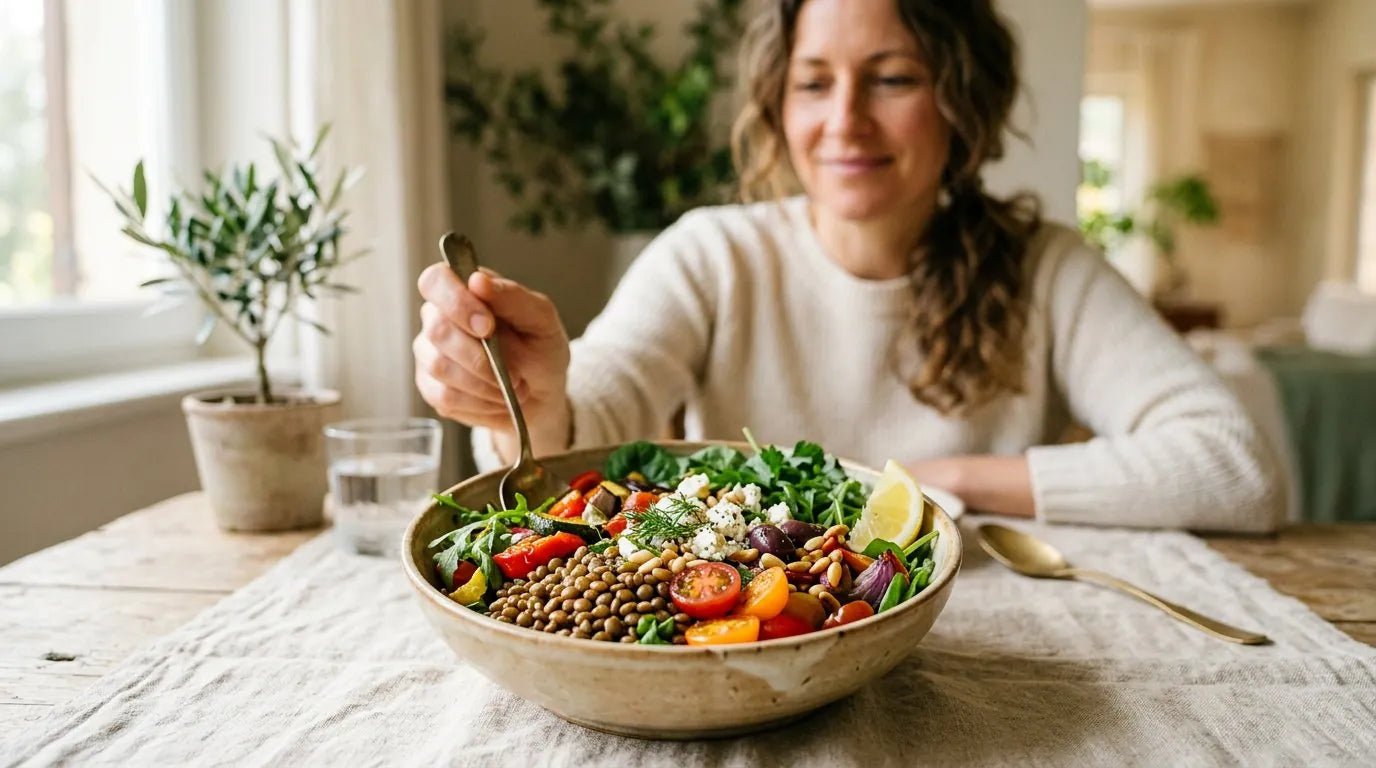
What does a good day look like? Breakfast, lunch, dinner

Three practical examples that together cover protein distribution, fiber, and the Mediterranean approach. They are intended as ideas, not as rules.

  • Breakfast (approx. 25–30 g protein): 200 g Skyr or low-fat quark with 40 g rolled oats, a handful of berries, and 10 g walnuts. Or scrambled eggs made from three eggs with wholemeal bread, tomatoes, and a splash of olive oil.
  • Lunch: A bowl with lentils or chickpeas, whole grains (quinoa, bulgur, or brown rice), plenty of colorful vegetables, and an olive oil-tahini dressing. Optionally grilled fish or tofu.
  • Dinner (lighter, earlier): Salmon or tofu with steamed vegetables and a small portion of quinoa. Ideally about three hours before bedtime.

The German Nutrition Society (DGE) recommends at least 30 grams of fiber per day. This value can be easily achieved with whole-grain products, legumes, berries, nuts, flaxseed, and plenty of vegetables.

Midlife Bundle: Targeted Support for Midlife

The Mediterranean base cannot be replaced. However, supplementing with micronutrients and botanicals that are difficult to obtain sufficiently through food in everyday life can be beneficial. This bundle is specially developed for women in their prime by doctors. Laboratory tested and manufactured in Austria.

€125,00

Discover Midlife Bundle

Fiber, the Gut, and the Estrobolome

Regardless of hormone status, fiber is one of the most effective levers for cardiovascular risk, blood sugar, and satiety. During menopause, another aspect comes into play: the gut flora, through the so-called estrobolome, modulates how the body reabsorbs or excretes estrogens.

The mechanistic link is plausible and a subject of active research, but it has not yet been sufficiently proven clinically. In practical terms, this means: 30 grams of fiber per day are beneficial, even if the specific effect via the estrobolome on menopausal symptoms has not yet been demonstrated in randomized studies.

Soy, Flaxseed and Co.: Phytoestrogens in Food

Plant-based phytoestrogens such as isoflavones from soy or lignans from flaxseed fit well into a Mediterranean diet. A small randomized study (Barnard et al., Menopause 2021, WAVS, n=38, 12 weeks) showed a significant reduction in moderate to severe hot flashes with a plant-based diet including half a cup of cooked soybeans daily. Important for classification: small sample size, short duration, and a large placebo effect in the control group.

For everyday life, this means: tofu, tempeh, edamame, soy milk, miso, and flaxseed are a useful addition to the diet, but not a substitute for hormone therapy. How phytoestrogens work biologically and which supplements have been studied is the subject of our article on Plant Compounds in Menopause.

What you should reduce: Alcohol, Caffeine, and Highly Processed Foods

Blanket prohibitions are rarely helpful. However, three points have good data:

  • Alcohol: The North American Menopause Society explicitly recommends moderation in its 2023 position statement. Higher consumption is associated with stronger vasomotor symptoms, poorer sleep, lower bone density, and increased breast cancer risk.
  • Caffeine: A study of approximately 1,800 women (Faubion et al., Menopause 2014) showed a small but significant association between caffeine and the severity of hot flashes. Those who are sensitive can test individually.
  • Highly Processed Foods: Several meta-analyses link a high proportion of ultra-processed foods to a higher risk of obesity, diabetes, and cardiovascular diseases. These endpoints increase anyway in the weeks after menopause, which is why a reduction has a particularly strong impact.

Detailed triggers for hot flashes and non-hormonal strategies can be found in our Hot Flash Guide.

Get medical support, comfortably from home

Every woman's symptoms, values, and life circumstances are different. In a free initial consultation with our medical team, we will personally assess nutrition, possible blood tests, and hormone therapy for you.

Book a free consultation call

Calcium, Vitamin D, and Iron through Diet

With the decline in estrogen, the risk of osteoporosis increases significantly, making calcium and vitamin D crucial. The DGE recommends 1,000 mg of calcium per day for adults and an estimated 20 micrograms of vitamin D per day if the body's own production through sunlight is insufficient. Iron remains important after menopause at 10 mg per day, but the requirement decreases compared to premenopausal years.

Good food sources are:

  • Calcium: Dairy products, calcium-rich mineral water, broccoli, kale, sesame, almonds, plant-based drinks fortified with calcium.
  • Vitamin D: Fatty fish like salmon, herring, and mackerel, eggs, mushrooms. It is difficult to meet the demand through diet alone; between March and October, 15 to 20 minutes of daily sun exposure to the face and arms helps.
  • Iron: Legumes, whole grains, oatmeal, spinach in combination with vitamin C-rich fruits for better absorption.

Important: In its statement 031/2025, the Federal Institute for Risk Assessment warns against high-dose bolus administrations of vitamin D at weekly or monthly intervals. If in doubt, have your vitamin D level medically determined instead of supplementing blindly and highly. Magnesium is another frequently discussed topic and has its own guide on hormonic.de.

Does intermittent fasting help during menopause?

For most postmenopausal women, intermittent fasting is safe and can aid in weight management. Small randomized studies on time-restricted eating (Cienfuegos et al. 2021) and alternate-day fasting (Lin et al. 2021) show comparable or slightly better effects on weight and insulin sensitivity than in premenopausal women. Kalam et al. 2023 found no unfavorable changes in reproductive hormones.

Intermittent fasting is not suitable for individuals with a history of eating disorders, very high stress or training loads, low body weight, or untreated thyroid problems. If in doubt, please consult a doctor.

Hydration and Drinks during Menopause

The DGE recommends that women consume about 1.5 liters of fluid from beverages per day, plus about 0.7 liters from food. Water and unsweetened tea are the basis, coffee also counts. Sugary drinks and fruit juices should remain the exception.

What you should no longer believe

  • Apple cider vinegar in the morning regulates blood sugar during menopause: There is no reliable data for the specific situation of menopause.
  • Phytoestrogens replace estrogen or hormone therapy: They are significantly weaker and are not an alternative for severely burdensome symptoms.
  • Certain foods shift menopause: Based on a single observational study that has not been replicated.
  • Detox teas during menopause: The liver and kidneys handle detoxification without a special tea program.

Common Questions About Nutrition in Menopause

What should you eat during menopause?

Mediterranean and plant-based with adequate protein: plenty of vegetables, whole grains, legumes, olive oil, nuts, fish once or twice a week, and moderate amounts of dairy products and poultry. The goal is high nutrient density with a slightly reduced calorie intake. The 2020 EMAS Position Statement rates the Mediterranean diet as the best-evidenced recommendation for the menopausal phase.

Which foods should be avoided during menopause?

There's no need to completely forbid anything. Reduction is beneficial for highly processed foods (sausages, ready-made sauces, pastries, sweetened drinks), for alcohol (NAMS 2023 recommends moderation), and for caffeine if hot flashes are sensitive to it.

How much protein do I need per day during menopause?

Approximately 1.0 to 1.2 grams per kilogram of body weight per day, which for a 65 kg person is about 65 to 80 grams. It is important to distribute this across three meals, each with 25 to 30 grams of high-quality protein, because women aged about 60 and older only achieve maximum muscle protein synthesis above this threshold (Layman 2024).

What's a good breakfast during menopause?

High in protein and fiber. For example, 200g of Skyr or low-fat quark with oats, berries, and walnuts. Or scrambled eggs made from three eggs with wholemeal bread, tomatoes, and a splash of olive oil. Pure sweet pastries or toast with jam will not keep you full for long and will destabilize your blood sugar.

Does intermittent fasting help during menopause?

For most postmenopausal women, yes. Small randomized studies (Cienfuegos et al. 2021, Lin et al. 2021) show comparable or slightly better effects on weight and insulin sensitivity than in younger women. Not suitable for those with a history of eating disorders, high stress or training load, or underweight.

Scientific Sources

  • Cano A, Marshall S, Zolfaroli I et al. (2020). The Mediterranean diet and menopausal health: An EMAS position statement. Maturitas 139:90–97. doi:10.1016/j.maturitas.2020.07.001
  • Herber-Gast GC, Mishra GD. (2013). Fruit, Mediterranean-style, and high-fat and -sugar diets are associated with the risk of night sweats and hot flushes in midlife. Am J Clin Nutr 97(5):1092–1099. doi:10.3945/ajcn.112.049965
  • Barnard ND, Kahleova H, Holtz DN et al. (2021). The Women's Study for the Alleviation of Vasomotor Symptoms (WAVS). Menopause 28(10):1150–1156. doi:10.1097/GME.0000000000001812
  • Bauer J et al., PROT-AGE Study Group. (2013). Evidence-based recommendations for optimal dietary protein intake in older people. JAMDA 14:542–559.
  • Rizzoli R, Stevenson JC, Bauer JM et al. (2014). The role of dietary protein and vitamin D in maintaining musculoskeletal health in postmenopausal women: An ESCEO/EMAS consensus. Maturitas 79:122–132.
  • Layman DK. (2024). Impacts of protein quantity and distribution on body composition. Front Nutr 11:1388986. doi:10.3389/fnut.2024.1388986
  • Cienfuegos S et al. (2021). Time-restricted feeding in premenopausal versus postmenopausal women. Exp Gerontol 154:111545. doi:10.1016/j.exger.2021.111545
  • Lin S et al. (2021). Weight-loss efficacy of alternate-day fasting by sex and menopausal status. Nutr Metab Cardiovasc Dis 31:833–840.
  • Kalam F et al. (2023). Time-restricted eating and sex hormones in postmenopausal women. Obesity 31(Suppl 1):57–62.
  • Faubion SS et al. (2014). Caffeine and menopausal vasomotor symptoms. Menopause. doi:10.1097/GME.0000000000000301
  • NAMS / The Menopause Society. (2023). The 2023 nonhormone therapy position statement. Menopause 30(6):573–590.
  • German Nutrition Society. (2024/2025). Reference values for nutrient intake, 3rd edition. Calcium, vitamin D, protein, fiber.
  • Federal Institute for Risk Assessment. (2025). Opinion 031/2025 on high-dose vitamin D.
  • AWMF S3 Guideline 015-062. (2020). Peri- and Postmenopause: Diagnostics and Interventions.

About the Author

Lisa Maria Emmer

Lisa Maria Emmer

Medical Director · Hormonic

Lisa Maria Emmer is co-founder and medical director at Hormonic. She supports women with hormonal problems every day and specializes in cycle health, PCOS, and menopause.

This article is based on current guidelines and scientific literature (as of 2026). It is intended for informational purposes only and does not replace medical advice, diagnosis, or treatment. If you have existing medical conditions, are pregnant or breastfeeding, or are taking medication, please consult a doctor before changing your diet or taking supplements.

Share

You might also be interested in this.
Staubtrocken, aber nicht hoffnungslos: Das hilft bei Scheidentrockenheit und Libidoverlust in den Wechseljahren
WechseljahreMar 6, 202612 min read
Bone-dry but not hopeless: How to combat vaginal dryness and loss of libido during menopause

When intimacy suddenly becomes bone dry, many women feel alone. But vaginal dryness and loss of libido during menopause are common – and treatable. This guide shows you why your body is changing an...
Gewichtszunahme in den Wechseljahren: Ursachen, Hormone & was wirklich hilft
WechseljahreNov 18, 202512 min read
Weight gain during menopause: causes and what really helps

Why do women gain weight during menopause – and what really helps? Learn about the hormonal causes, typical mistakes & scientifically sound strategies for weight loss.

Frau Mitte 40 in heller Küche am Morgen, hält Schälchen mit Supplements, warme Töne, Wechseljahre Magnesium
WechseljahreMay 24, 20268 min read
Magnesium in Menopause: What the Research Says

Magnesium can support sleep, mood, and bones in perimenopause and postmenopause. Here's what the research actually says, which forms work best, and what magnesium can't do.