

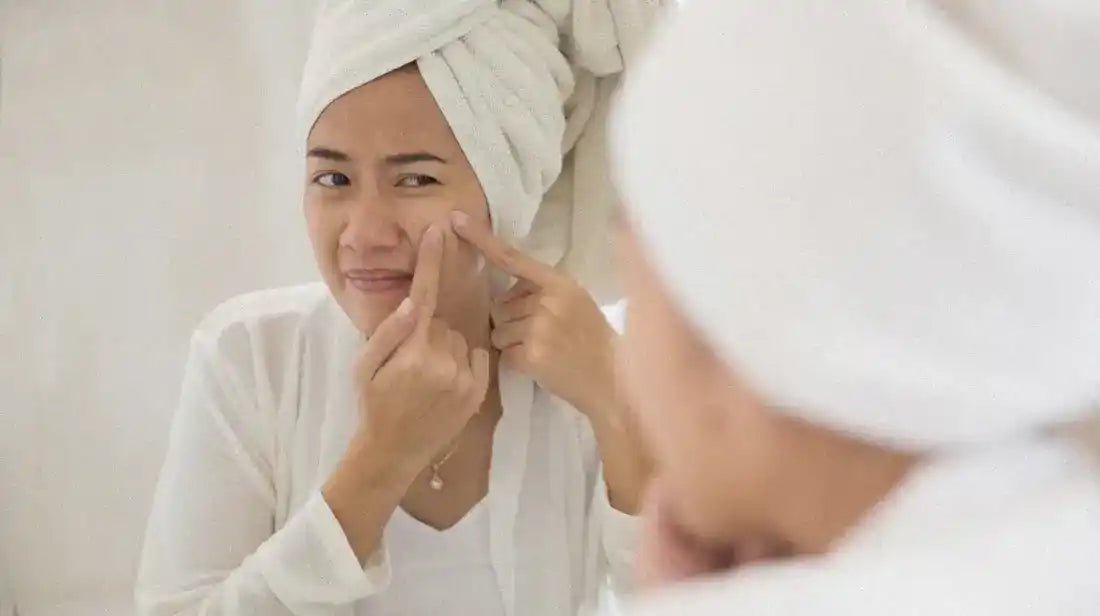
Clear skin in puberty, and then suddenly in your late 20s the first deep pimples on your chin? You're not alone. Around 22 percent of women are affected by acne even in adulthood, often cyclically and in the lower face area. This article explains why hormones are behind it and which approaches are truly supported by research.
Hormonal acne is a form of adult female acne that is increasingly understood as hormonal, with androgens being a central factor. The skin is not only a target organ but also produces and regulates hormones itself. In this article, we honestly classify causes, active ingredients, and approaches based on evidence.
Last updated: August 2026
How do hormones cause skin blemishes?
Androgens such as testosterone and dihydrotestosterone (DHT) play the main role in the development of hormonal acne. Important: The skin is not just a passive receiver, but partly produces and activates these hormones itself. Androgens can therefore act locally in the skin, even if androgen levels in the blood are completely normal. This is precisely why many women with blemished skin have normal blood values. The local skin environment is crucial.
Androgens stimulate the sebaceous glands to produce more sebum and promote the keratinization of skin cells. Both together clog the pores. In this oily environment, the bacterium Cutibacterium acnes multiplies and triggers inflammation, leading to blackheads, pustules, and inflamed nodules.
Not all hormonal acne means too many hormones. Often, the skin is just more sensitive to them.
Women with polycystic ovary syndrome (PCOS) are particularly susceptible because they often have systemically elevated androgen levels. However, hormonal acne affects far more than just them: even with normal blood values, increased skin sensitivity to androgens can lead to blemishes.
Which active ingredient does what?
This overview helps you quickly classify the most important external active ingredients for hormonal acne:
| Active ingredient | Effect | Good to know |
|---|---|---|
| Salicylic acid (BHA) | dissolves keratinization, clears pores | gentle, good for blackheads |
| Retinoids | cell renewal, anti-inflammatory | introduce gradually, sun protection, not during pregnancy |
| Azelaic acid | antibacterial, lightens acne marks | considered safe for use during pregnancy |
| Benzoyl peroxide | antibacterial against C. acnes | 2.5% is often sufficient, apply topically |
| Niacinamide | regulates sebum, soothes redness | very well tolerated |
stress also affects the skin? When stressed, the body releases more cortisol, which can make the sebaceous glands more active and shift androgen balance. Poor sleep and chronic stress therefore often show up on the skin.
Hormonic Base: Nutritional Foundation for the Skin
Hormonic Base provides 16 well-dosed micronutrients as a daily foundation for the skin: zinc contributes to the maintenance of normal skin, selenium and vitamin E protect cells from oxidative stress, and it contains curcumin and NAC, two substances highly regarded in inflammation research. A stable foundation that supplements a skin-friendly diet and does not replace medical treatment.
€65,00
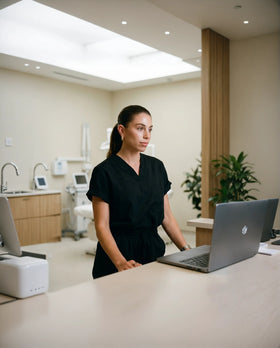
More than a few pimples? We'll take a look together
If your skin condition is accompanied by irregular cycles, suspected PCOS, or significant distress, it's about more than just skincare. In a personal video consultation, we medically assess your situation, without making any promises.
Common Questions About Hormonal Acne
How do I know if my acne is hormonal?
Does zinc help with hormonal acne?
Sollte ich bei hormoneller Akne auf Milch verzichten?
Wie lange dauert es, bis sich die Haut bessert?
Scientific Sources
- Systematic Review with GRADE (2025). The Role of Glycemic Load, Dairy, and Fatty Acids in Acne: A Systematic Review and Meta-Analysis. Medicinus / UPH.
- Basendwh M.A. et al. (2024). The efficacy of topical clascoterone versus systemic spironolactone for acne vulgaris: a systematic review and network meta-analysis. PLOS ONE, 19(5), e0298155. doi:10.1371/journal.pone.0298155
- Zaenglein A.L. et al. (2016). Guidelines of care for the management of acne vulgaris. Journal of the American Academy of Dermatology, 74(5), 945-973. doi:10.1016/j.jaad.2015.12.037
- Jung J.Y. et al. (2014). Effect of dietary supplementation with omega-3 fatty acid and gamma-linolenic acid on acne vulgaris: a randomised, double-blind, controlled trial. Acta Dermato-Venereologica, 94(5), 521-525. doi:10.2340/00015555-1802
- Grant P. (2010). Spearmint herbal tea has significant anti-androgen effects in polycystic ovarian syndrome: a randomized controlled trial. Phytotherapy Research, 24(2), 186-188. doi:10.1002/ptr.2900
- Zacche M.M. et al. (2009). Efficacy of myo-inositol in the treatment of cutaneous disorders in young women with polycystic ovary syndrome. Gynecological Endocrinology, 25(8), 508-513. doi:10.1080/09513590903015544
- Lim S.K. et al. (2016). Comparison of Vitamin D Levels in Patients with and without Acne and its Association with Severity. PLOS ONE, 11(8), e0161162. doi:10.1371/journal.pone.0161162
- Vaidya T., Hoffman L., Chapas A. (2024). Evaluating common ingredients contained in dietary acne supplements: an evidence-based review. Journal of Clinical and Aesthetic Dermatology, 17(1), 34-41.
- Meixiong J. et al. (2022). Diet and acne: a systematic review. JAAD International, 7, 95-112. doi:10.1016/j.jdin.2022.02.012
- Li Y. et al. (2024). Skin as an endocrine organ and androgen signalling in acne.
About the Author

You might also be interested in this.
These 4 supplements are recommended daily by science for women: Micronutrient basis, Omega-3, Creatine, and targeted gut-hormone add-ons. Without hype, with a study basis.

PCOS, now also known as PMOS, affects 8 to 13 percent of women of reproductive age. This guide explains causes, symptoms, diagnosis, and what the evidence says about lifestyle, inositol, and micron...

Why women lose hair, what's behind diffuse hair loss, and which measures are scientifically proven. Medically reviewed overview of causes, the hair cycle, and the most important nutrients.