

Quercetin is a well-researched flavonoid with connections to hormonal health. Studies show it has anti-inflammatory, insulin-related, and antiandrogenic properties. What's crucial here is not just the dosage, but rather its absorption and combination with other plant compounds. This article explains what the research truly shows.
In my consultations, women often show me their small supplement collection, and almost always it includes a high-dose quercetin. My first follow-up question is usually: How well is it actually absorbed? Because the large number on the bottle says surprisingly little about how much of it actually reaches your cells. That's exactly what this article is about.
Quercetin is one of the most well-researched flavonoids related to hormone health. In clinical studies, effects on androgens, insulin sensitivity, and inflammatory markers have been observed in PCOS. Two things are often overlooked: Quercetin alone is poorly absorbed, and it is most effective when combined with other plant compounds. This is precisely why the pure milligram count on a package says less than many people think.
What is Quercetin?
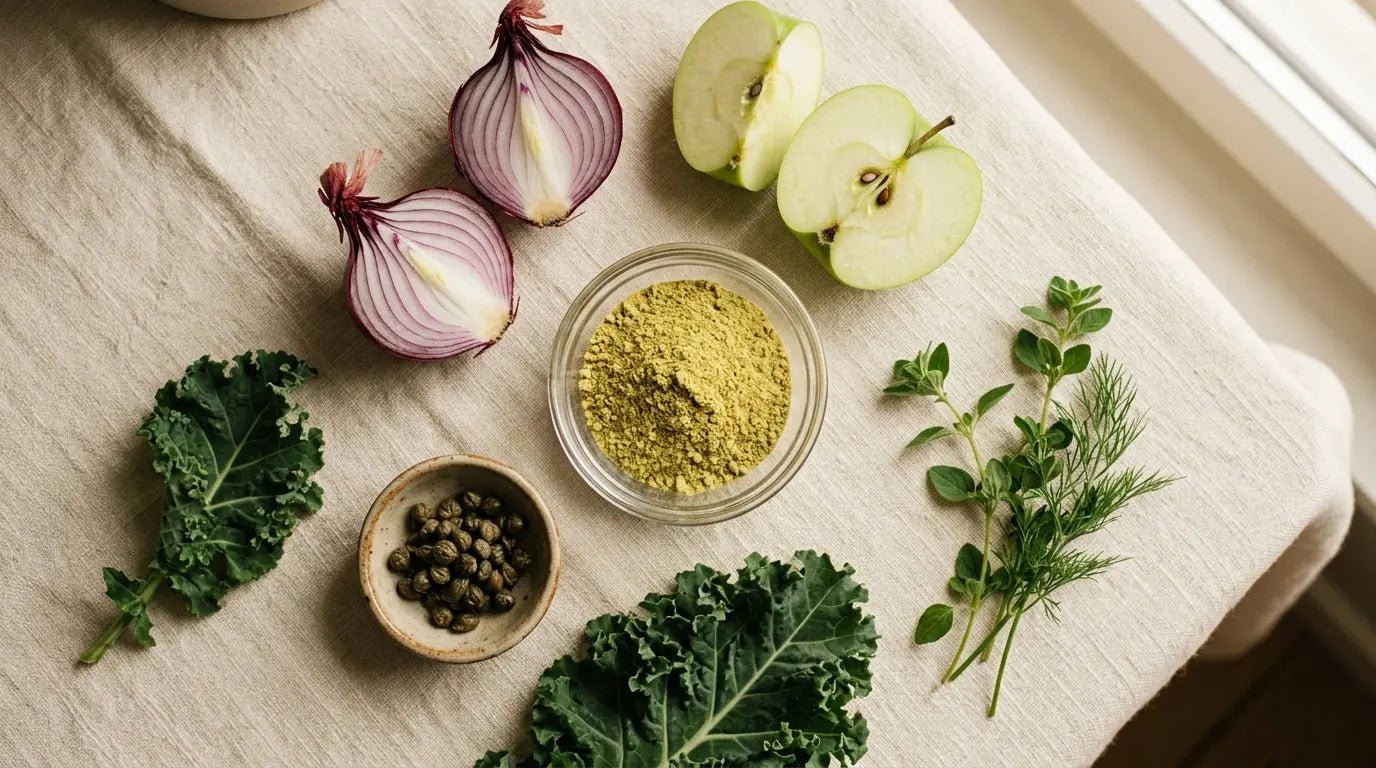
Quercetin is found in high concentrations in many plant foods. Dietary intake can naturally support quercetin status.
Capers
~234 mg/100g
Dried Dill
~55 mg/100g
Red Onions
~39 mg/100g
Kale
~23 mg/100g
Oregano
~42 mg/100g
Apples with skin
~4 mg/100g
What do clinical studies show for PCOS?
Between 50 and 70 percent of women with PCOS have insulin resistance. Quercetin is increasingly being researched in this context because it could act through several mechanisms simultaneously.
Androgens and LH
Vaez et al. (2023) observed changes in testosterone and LH levels in PCOS patients taking quercetin. Habiburrahman et al. (2023) also reported changes in hormonal markers. Whether these lead to clinically relevant effects is still under investigation.
Vaez et al. 2023; Habiburrahman et al. 2023
AMPK and Glucose Uptake
Dhanya et al. (2022) described that quercetin could activate AMPK signaling pathways and influence glucose uptake in experimental models. Rezvan N et al. (2017) observed effects on adiponectin receptors and AMPK in PCOS patients.
Dhanya et al. 2022; Rezvan N et al. 2017
Cytokines and NF-kB
Several studies describe an influence on pro-inflammatory cytokines such as TNF-alpha and IL-6, which are often elevated in PCOS. Quercetin inhibits NF-kB signaling pathways in experimental models.
Amiri et al. 2022; Gorczyca et al. 2022; Islam et al. 2022
Bacterial Composition
Changes in gut microbiota often occur in PCOS. Experimental models have investigated whether quercetin influences bacterial composition and short-chain fatty acid production. Promising, but no clinical confirmation yet.
Cani PD et al.
Classification of Evidence
The results to date are promising, but the data is still heterogeneous. There are no approved health claims for quercetin yet. General therapy recommendations cannot be derived from the current studies. Further high-quality RCTs are necessary.
Bioavailability: why milligrams don't equal effect
Quercetin has a central practical problem: it is poorly absorbed by the body. The bioavailability of pure quercetin is low, less than 20 percent depending on the form, and a large portion is excreted within a few days (Andres et al. 2018). This means that a high number on the packaging says little about how much of it actually reaches your cells.
This is precisely the crucial point. It is not the isolated milligram amount that is decisive, but how well the substance is absorbed and with what other substances it is combined. Several factors demonstrably improve absorption:
| Measure | Effect | Evidence |
|---|---|---|
| Combine with Vitamin C | Measurably improves plasma levels | Shafabakhsh et al. 2019 |
| Combine with Folate | Increased absorption | Shafabakhsh et al. 2019 |
| Take with Fat | Better absorption (olive oil, avocado) | Andres et al. 2018 |
| Regular intake | Improves bioavailability over time | Andres et al. 2018 |
| Other Polyphenols | Possible synergistic effect and better absorption | Shafabakhsh et al. 2019 |
For this reason, it makes more sense to view quercetin not as a single active ingredient in a high dose, but as a building block in a well-thought-out interplay of several plant compounds. We will look at what this interplay looks like next.
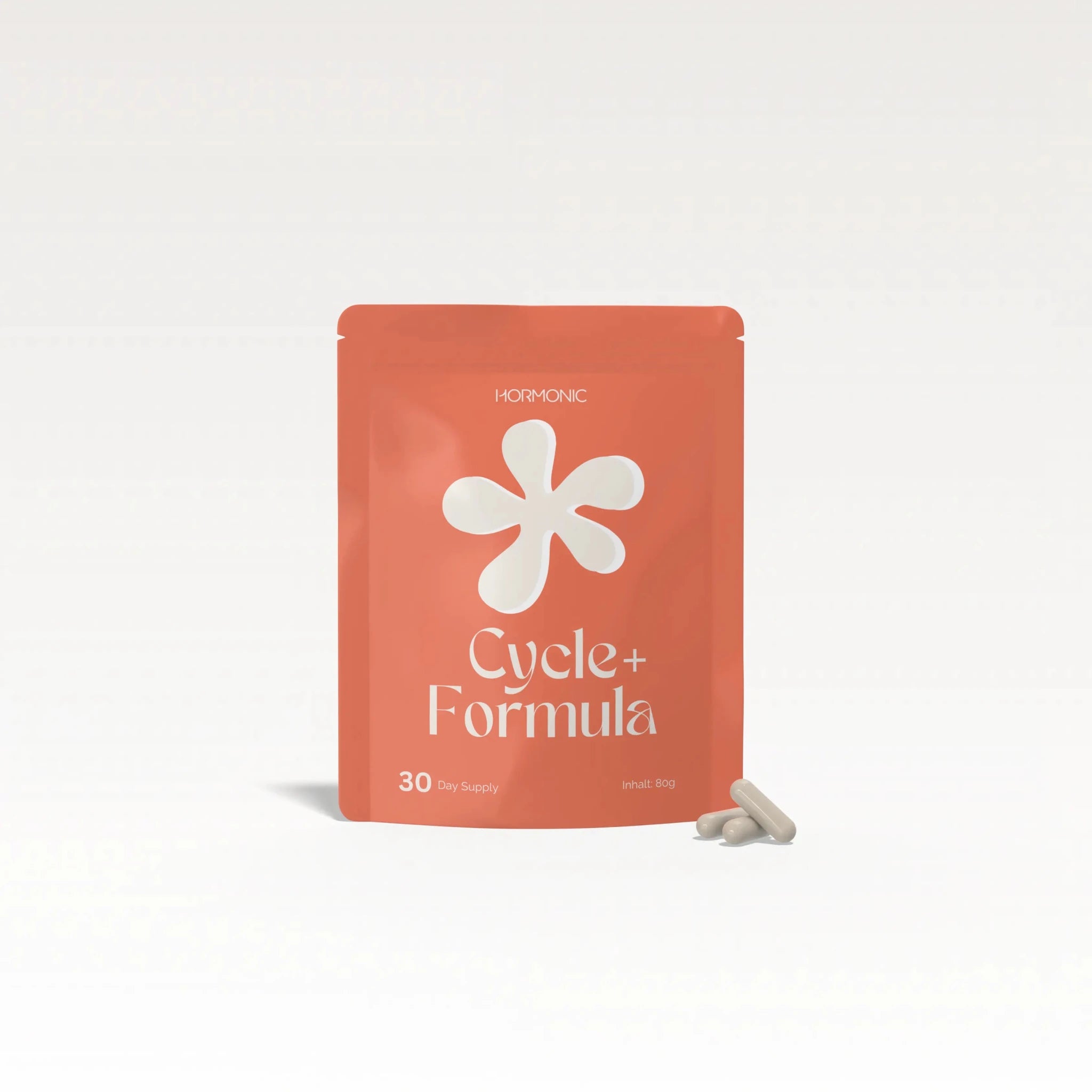
Cycle+ Formula: Quercetin cleverly combined
This is exactly why Cycle+ Formula does not rely on a high single dose, but combines quercetin with trans-resveratrol, myo- and D-chiro-inositol, and zinc, which contributes to normal fertility and reproduction. A well-thought-out interplay of several plant compounds instead of milligram marketing.
Discover Cycle+ Formula
Cycle+: Polyphenols plus myo-inositol, intelligently combined
Because quercetin alone is poorly absorbed, Cycle+ Formula relies on a well-thought-out interplay: quercetin and trans-resveratrol combined with myo- and D-chiro-inositol, and with zinc, which contributes to normal fertility and reproduction. Developed as a daily supplement to Hormonic Base.
€75,00
Questions about quercetin and your hormone profile?
The first 15 minutes with one of our doctors are free of charge. We'll examine your symptoms and values and tell you honestly if and how Quercetin and Co. fit into your plan.
Frequently Asked Questions about Quercetin
What does quercetin do for PCOS?
How much quercetin should one take?
Which foods are high in quercetin?
Does quercetin have side effects?
Is quercetin the same as apigenin?
Scientific Sources
- Andres S et al. (2018). Safety Aspects of the Use of Quercetin as a Dietary Supplement. Molecular Nutrition and Food Research.
- Rezvan N et al. (2017). Effects of Quercetin on Adiponectin-Mediated Insulin Sensitivity in Polycystic Ovary Syndrome: A Randomized Placebo-Controlled Double-Blind Study. Hormone and Metabolic Research.
- Vaez S et al. (2023). Quercetin and androgen markers in PCOS.
- Habiburrahman M et al. (2023). Quercetin effects on hormonal and metabolic markers in PCOS.
- Dhanya R et al. (2022). Quercetin and AMPK activation in experimental models of insulin resistance.
- Mantadaki AE et al. (2024). Quercetin supplementation and quality of life in patients with type 2 diabetes.
- Jian X et al. (2024). Efficacy and safety of dietary polyphenol administration in patients with PCOS: a meta-analysis and systematic review. Critical Reviews in Food Science and Nutrition.
- Unfer V et al. (2017). Myo-inositol effects in women with PCOS: a meta-analysis of randomized controlled trials. Endocrine Connections.
- Resveratrol in women with polycystic ovary syndrome: a systematic review and meta-analysis of randomized clinical trials (2023).
- Apigenin and polycystic ovary syndrome: a comprehensive review of phytochemical evidence. Frontiers in Endocrinology (2025).
- Shafabakhsh R et al. (2019). Bioavailability of quercetin and enhancement strategies.
- Amiri P et al. (2022). Quercetin and inflammatory cytokines.
- Gorczyca G et al. (2022). Quercetin in inflammatory signaling pathways.
- Islam T et al. (2022). Quercetin and cytokine profiles.
- Cani PD et al. Gut microbiota and metabolic health (review).
You might also be interested in this.

PCOS, now also known as PMOS, affects 8 to 13 percent of women of reproductive age. This guide explains causes, symptoms, diagnosis, and what the evidence says about lifestyle, inositol, and micron...

How does inositol work for PCOS, what do studies show regarding ovulation, testosterone, and insulin resistance, and what is a sensible dosage? The evidence-based overview.

Elevated androgens manifest as acne, hair loss, and menstrual irregularities. We explore the underlying biology and evidence-based effective interventions.