

"There is a cyst on the left ovary; we'll take another look in two months." With this sentence and an appointment in eight weeks, a woman in her late twenties left the practice. She spent the next few weeks Googling, and every page made her more anxious. When she asked me if she shouldn't actually have surgery right away, she was completely distraught. At the follow-up appointment, the cyst had disappeared.
This is how it goes for the vast majority of women. Nevertheless, an ovarian cyst on a report can cause uncertainty, and that is understandable. In this article, you will learn what types of cysts there are, what symptoms they can cause, when it is right to wait, what warning signs you should know, and why PCOS is not the same as an ovarian cyst.
What types of ovarian cysts are there?
Ovarian cysts can be broadly divided into functional cysts and non-functional cysts. Functional cysts develop as part of the normal cycle and are the most common form in women of reproductive age. Non-functional cysts develop from other tissue and usually do not disappear on their own.
A follicular cyst develops when a mature follicle does not rupture during ovulation and continues to accumulate fluid. A corpus luteum cyst forms after ovulation when the corpus luteum, which produces progesterone, fills with fluid or blood. Both are directly related to the cycle.
Non-functional cysts include the endometrioma, also known as a chocolate cyst, which develops in endometriosis and is filled with old blood; the dermoid cyst, which arises from germ cells and can contain tissue such as hair or sebum; and cystadenomas, benign growths on the surface of the ovary. You can read more about endometriomas in our article on chocolate cysts.
| Cyst type | Development | Course | Typical procedure |
|---|---|---|---|
| Follicular cyst | Follicle does not rupture during ovulation | Usually disappears within 1 to 3 cycles | Ultrasound monitoring |
| Corpus luteum cyst | Corpus luteum fills with fluid or blood | Usually disappears spontaneously | Monitoring, investigation if there is pain |
| Endometrioma | Endometriosis on the ovary | Usually persists | Hormone therapy or surgery |
| Dermoid cyst | From germ cells, contains tissue | Grows slowly, persists | Usually surgically removed |
| Cystadenoma | Benign growth on the surface | Can grow larger | Usually surgically removed |
After menopause, there is no more ovulation, so functional cysts are rare then. A newly discovered cyst is investigated more carefully during this phase of life, even though most are also benign.
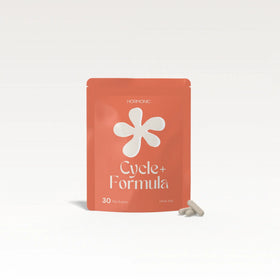
Hormonic Base for Hormones, Cells & Cycle
If PCOS and irregular ovulation are your main concerns: Cycle+ combines 8 active ingredients, including myo-inositol and D-chiro-inositol, which have been studied in relation to ovulation in PCOS, and zinc, which contributes to normal fertility. Cycle+ has no proven effect on true ovarian cysts.
Cyst in the report and unsure what that means?
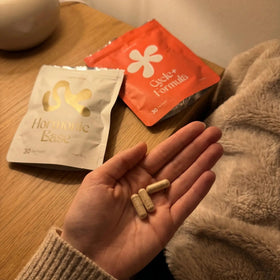
If you are focusing on your menstrual cycle: Hormonic Base provides the 16 essential micronutrients you need every day. Cycle+ adds 8 active ingredients, including myo-inositol and D-chiro-inositol, which have been studied in relation to ovulation and the menstrual cycle, and zinc, which contributes to normal fertility. Developed by doctors and made in Austria.
Frequently Asked Questions About Ovarian Cysts
Is an ovarian cyst dangerous?
How long does it take for an ovarian cyst to go away?
Welche Symptome hat man bei einer Zyste am Eierstock?
Kann eine Zyste am Eierstock die Periode verschieben?
Scientific Sources
- Gareeballah A, Gameraddin M, Alshoabi SA, et al. (2025). The diagnostic performance of International Ovarian Tumor Analysis: Simple Rules for diagnosing ovarian tumors: a systematic review and meta-analysis. Frontiers in Oncology 14:1474930. doi:10.3389/fonc.2024.1474930
- Fitz V, et al. (2024). Inositol for Polycystic Ovary Syndrome: A Systematic Review and Meta-analysis to Inform the 2023 Update of the International Evidence-Based PCOS Guidelines. Journal of Clinical Endocrinology & Metabolism 109(6):1630-1655. doi:10.1210/clinem/dgad762
- International PCOS Network (2023). Recommendations from the 2023 International Evidence-based Guideline for the Assessment and Management of Polycystic Ovary Syndrome. Fertility and Sterility 120(4):767-793. doi:10.1016/j.fertnstert.2023.07.025
- Bridwell RE, Koyfman A, Long B (2022). High risk and low prevalence diseases: Ovarian torsion. American Journal of Emergency Medicine. doi:10.1016/j.ajem.2022.03.046
- Grimes DA, Jones LB, Lopez LM, Schulz KF (2014). Oral contraceptives for functional ovarian cysts. Cochrane Database of Systematic Reviews. doi:10.1002/14651858.CD006134.pub5
About the Author

You might also be interested in this.
A chocolate cyst sounds more harmless than it feels. Here you will learn what an endometrioma is, when monitoring, medication or surgery may be options, and what this means for your ovarian reserve...

PCOS is diagnosed using the Rotterdam criteria: at least two out of three features plus the exclusion of other causes. This is how the assessment is carried out, including hormone markers, ultrasou...

Ovulation pain, cervical mucus, nausea: Ovulation manifests through many signs. Find out which ovulation symptoms are typical, how long ovulation pain lasts, and how to identify your fertile days.