

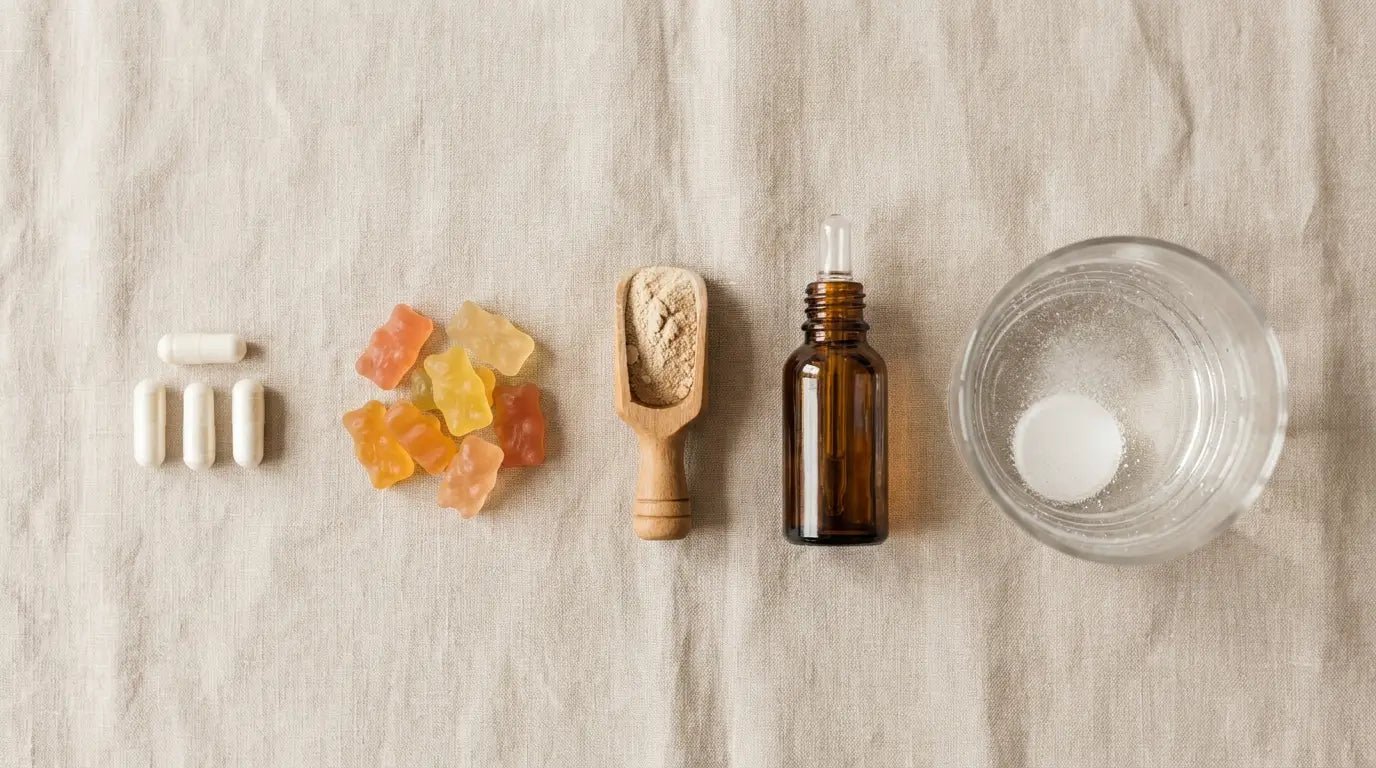
Capsule, gummy, patch, spray, powder, or drops? Dietary supplement delivery forms are becoming increasingly creative. Now there are even patches for the tongue, skin patches, or tasty gummy bears intended to provide you with vitamins and plant-based substances. But do they actually work? This article compares these forms honestly and scientifically so that you know what really matters.
In a nutshell
- For most nutrients, no form is better absorbed than a well-made capsule.
- The decisive factors are not marketing fluff, but an accurate dose, bioavailability, stability, and your consistency in taking the supplement.
- Vitamin patches are one form that is not backed by science: most active ingredients are barely absorbed through the skin.
- Gummy bears taste delicious, but they often contain only low doses and are frequently full of additives and sugar.
- Powders are good for high doses, whereas effervescent tablets often contain a lot of sodium.
When I compared the studies on the various delivery forms for Hormonic, one thing surprised me most: how much good marketing campaigns can deceive customers. Supplement patches, sprays, and colorful gummy bears often promise a powerful effect and better absorption, but the evidence for this is usually thin.
What really counts is less spectacular: the right chemical form of the nutrient, the appropriate dose, combining it with a meal in the case of fat-soluble vitamins, and simply taking the preparation regularly. Let's go through the forms one by one.
The most important finding first
For the vast majority of people, no format is systematically better absorbed than a well-formulated capsule. Whether water-soluble vitamins like C or B12 come from a capsule, spray, or gummy usually makes little difference to blood levels. The nutrient itself, the dose, and the context of intake are more important than the shell.
Legally, too: the health claims approved by the European Food Safety Authority (EFSA) always refer to the nutrient and the necessary quantity, not to the delivery form. A statement like "vitamin D contributes to normal immune function" applies equally to capsules, drops, or sprays, as long as the form provides the promised amount. A form cannot, therefore, advertise better efficacy without proving it. This is a problem. Imagine the nutrient is applied to the skin, but is not absorbed through the skin at all. The company would still be allowed to advertise it with the phrase "contributes to normal immune function." But wait a minute, how is that supposed to work if nothing of it passes through the skin?
Let's take a look at a comparison of the different delivery forms.
| Form | Strength | Weakness |
|---|---|---|
| Capsule / Tablet | accurate dosage, minerals and high amounts also possible, can reach the intestine with the right capsule shell, highly stable, requires no flavorings | hard for some to swallow, fillers used by some manufacturers |
| Gummy | taste, good acceptance, pleasant to take | fluctuating dosage, little room for high nutrient content, lots of sugar, hardly any minerals |
| Patch | convenient in concept | no proven absorption through the skin for most nutrients |
| Spray / sublingual | practical, useful for B12 | rarely better than a tablet, often contains flavorings |
| Powder | flexible, high doses very possible (e.g., useful for collagen) | taste, additives for solubility and color, less precise dosing by spoon |
| Drops / liquid | precisely dosable, good for children and vitamin D | less stable after opening |
| Effervescent tablet | dissolves quickly, pleasant | high sodium content, often sugar |
Capsules and tablets: the benchmark
Capsules and tablets are the reference for good reason. They can be dosed precisely and reproducibly, can also accommodate bulky minerals like magnesium, iron, or calcium as well as higher amounts, and are well protected against moisture and light, meaning they remain stable for a long time. In addition, different capsule shells can be chosen if active ingredients are intended to reach the intestine. For a combination product with many micronutrients, the capsule is therefore hard to beat.
However, it is also fair to say: not every tablet or capsule is automatically good. Poorly compressed tablets can dissolve too slowly and then release less, which is why there are quality standards for disintegration and dissolution. Conversely, rapid dissolution does not automatically mean better absorption. Furthermore, cheap forms can be used (e.g., magnesium oxide instead of higher-quality magnesium forms like bisglycinate), which affects efficacy. And the disadvantage remains: some people cannot or do not want to swallow capsules, and that is precisely why the other forms exist.
Tablet or capsule: Which is better?
Because both are the benchmark, a direct comparison is worthwhile. In terms of absorption, there is little difference between a well-made tablet and a well-made capsule; the difference lies in production and the details.
| Criterion | Tablet | Capsule |
|---|---|---|
| Production | Active ingredients are compressed under pressure, usually requires compressing agents and binders | Powder is filled loosely into a shell, often possible with fewer additives |
| Dissolution | can disintegrate more slowly if poorly compressed | usually opens quickly, intestinal release controllable via the shell |
| Tolerability | can be larger and more angular | glides easier for many, often easier on the stomach |
| Dose per unit | very high amounts possible, therefore often used for single nutrients | high, very good for combination products with many micronutrients |
In short: There is no overall winner. Anyone needing a single, very high-dose mineral is well served by a tablet. Anyone who wants many finely balanced micronutrients in a stomach-friendly, low-additive form is usually better off with a high-quality capsule. In both cases, quality beats the form.
Why Hormonic uses vegan capsules
Our formulas combine many finely balanced micronutrients, exactly the case where the capsule plays to its strengths: exact dosage, stomach-friendly, without unnecessary compressing agents or additives, and vegan. Hormonic Base provides 16 micronutrients in one vegan capsule, and our cycle- and life-phase-specific formulas are built on that.
View all formulas →Frequently asked questions
Are capsules better absorbed than tablets?
With good quality, there is little difference between the two. Capsules often dissolve more quickly and require fewer compressing agents and binders, but the decisive factors for absorption remain the chemical form of the nutrient, the dose, and regular intake.
Are tablets or capsules better for a sensitive stomach?
Many find capsules to be easier on the stomach because they are easier to swallow and the shell encloses the contents. Those who do not like to swallow capsules will find an alternative in powders or drops.
Are vegan capsules as good as gelatin capsules?
Yes. Plant-based capsule shells made of cellulose fulfill the same function as gelatin but are suitable for a vegan diet. Hormonic uses exclusively vegan capsules.
Hormonic Base: the capsule with a full dose
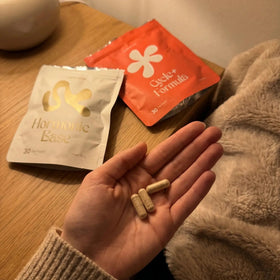
If you are looking for a solid foundation, the capsule form is hard to beat. Hormonic Base provides 16 micronutrients that the body needs daily for central processes, including vitamin D3, K2, zinc or magnesium – in other words, also those minerals that hardly fit into gummy bears. Developed by doctors, clinically dosed, without additives.
€65,00
Unsure what makes sense for you?
Take the free hormone quiz now and find out in just a few minutes what suits your situation and which supplements might make sense.
Frequently Asked Questions about Dosage Forms
What is the best form of food supplement?
Are vitamin patches absorbed by the body?
Sind Sprays oder sublinguale Tropfen besser als Tabletten?
Sind Gummis so gut wie Kapseln?
Scientific Sources
- Sundbom, M. et al. (2019). Is Transdermal Multivitamin Patch Effective in Gastric Bypass Patients? Obes Surg, 29(11). PMID: 31302845
- Kaur, G. et al. (2021). Transdermal patches for micronutrient delivery: a review of the evidence. (PMC8318979)
- Systematic review/meta-analysis (2025). Oral, sublingual and intramuscular vitamin B12: comparative effectiveness. Front Pharmacol. (PMC12757266)
- Sharabi, A. et al. (2003). Replacement therapy for vitamin B12 deficiency: sublingual vs oral route. Br J Clin Pharmacol, 56(6), 635-638. PMC1884303
- George, J. et al. (2013). Association between cardiovascular events and sodium-containing effervescent, dispersible and soluble drugs. BMJ, 347, f6954. PMID: 24284017
- United States Pharmacopeia. General Chapter <2040> Disintegration and Dissolution of Dietary Supplements.
- Enzymedica / iHerb Wellness Hub: Common fillers and excipients in supplements (Flavorings, sweeteners, anti-caking agents like silicon dioxide).
- Formulation literature: Capsules are tasteless and do not require taste masking or sweetening (clean label advantage over gummies, powders and liquids).
- Regulation (EC) No 1924/2006 on nutrition and health claims; EFSA scientific/technical guidance (EFSA Journal 2017;15(1):4680).
About the Author

You might also be interested in this.

Vitamin gummies taste like candy, but do they deliver on their promises? The honest downsides of vitamin gummies, scientifically classified.

Vitamin patches are booming on social media. But can nutrients really be absorbed through the skin? We take an honest and scientific look at the studies on supplement patches.

These 4 supplements are recommended daily by science for women: Micronutrient basis, Omega-3, Creatine, and targeted gut-hormone add-ons. Without hype, with a study basis.