For many women, histamine intolerance doesn't appear randomly, but in sync with their cycle. This article explains the symptoms, the often-overlooked hormonal connection, and what research and everyday practice suggest can help.
Sometimes a headache after a glass of wine, sometimes an itchy rash, sometimes bloating or heart palpitations, and seemingly without a pattern. Many women with histamine intolerance feel like they suddenly react to everything. What hardly anyone tells you: The symptoms often follow your cycle.
Definition
What is histamine intolerance?
With histamine intolerance, histamine builds up in the body because its breakdown cannot keep up. Histamine is found in many foods and is normally broken down in the intestine by the enzyme diamine oxidase (DAO). If too little DAO is active or too much histamine accumulates, a variety of symptoms can arise. It is not a classic allergy, but a question of the balance between histamine in and histamine out.
Am I suddenly sensitive to everything? The symptoms
Histamine acts throughout the body, which is why the symptoms are so diverse. Typically, they appear 30 minutes to several hours after histamine-rich food. Histamine intolerance often manifests in several of these areas simultaneously:
-
Head: Headaches or migraines
-
Skin: Redness, flushing, itching or hives
-
Digestion: Bloating, abdominal pain, nausea, loose stools
-
Respiratory tract: Stuffy or runny nose
-
Circulation: Heart palpitations, dizziness, low blood pressure
-
Psyche: Inner restlessness, irritability, sleep problems, as histamine also acts as a stimulating neurotransmitter in the brain
Because so many systems can be affected, histamine intolerance often goes undiagnosed for a long time. It is frequently mistaken for an allergy or another intolerance because the reaction looks similar. The difference: In an allergy, the immune system specifically reacts to a substance; in histamine intolerance, it's about the amount of histamine and the body's ability to break it down. Women are significantly more often affected than men, which further emphasizes the hormonal connection.
Histamine, mast cells and the enzyme DAO
Histamine is mainly produced in the body by mast cells, a type of immune cell, and is additionally absorbed through food. It is primarily broken down by diamine oxidase in the intestine. You can imagine it like a scale: As long as breakdown and production are in balance, you won't notice anything.
The image of a barrel is helpful: As long as your barrel still has space, you can tolerate individual triggers like a glass of wine or a piece of cheese without problems. If it's already almost full due to many small sources, a single drop will make it overflow, and the symptoms begin. In addition to DAO in the intestine, there is a second breakdown enzyme called HNMT, which mainly breaks down histamine in the cells.
If the scale tips, for example because DAO is genetically lower, the intestine is irritated, certain medications slow down the breakdown, or important building blocks are missing, histamine accumulates. And this is exactly where hormones come into play, a factor that is simply missing from most guides.
Not every reaction is an allergy. Often, it's a question of how well your body breaks down histamine.
The Hormone Factor: Why It Becomes Cyclical
Estrogen and histamine are closely linked. Estrogen stimulates mast cells to release more histamine. Conversely, histamine can stimulate the ovaries to produce more estrogen. Researchers describe this as a self-reinforcing cycle.
A second point is that estrogen can reduce DAO activity. If there is a lot of estrogen, histamine is broken down more slowly. Progesterone works in the opposite direction; it tends to stabilize mast cells and supports histamine breakdown.
Because estrogen and histamine egg each other on, this system is difficult to calm down on its own. More estrogen leads to more histamine, and more histamine, in turn, can trigger more estrogen. This is not a weakness or failure of your body, but a biological regulatory circuit that is simply more sensitively tuned in some women.
This explains the typical pattern in many women: symptoms often intensify around ovulation, when estrogen peaks, and again just before menstruation, when progesterone drops. If your symptoms follow this rhythm, it's a clear indication that hormones are involved, not just food.
This is also why histamine-related complaints and PMS often overlap. Histamine has a stimulating effect in the brain, and can therefore worsen restlessness, irritability, and sleep problems – precisely the symptoms many women experience in the second half of their cycle. Migraines that reliably occur before menstruation or around ovulation also fit this picture. A connection with endometriosis is also being discussed, as studies show that the lesions contain more active mast cells.
Menopause: Why Symptoms Can Worsen Now
During perimenopause, this system becomes particularly imbalanced. Progesterone often drops first, often years before estrogen is consistently low. This removes the stabilizing brake for mast cells, while estrogen still irregularly surges.
Experts describe that during this phase, DAO activity can decrease and mast cells can react more sensitively. This may explain why some women in menopause suddenly experience new or stronger symptoms such as hives, flushing, heart palpitations, or intolerances, often without realizing that histamine is behind it. Important to note: The connection is biologically understandable, but large clinical studies are still pending. That's precisely why it's worth considering this topic instead of simply accepting the symptoms as inevitable.
Quercetin: one of the best-studied herbal mast cell stabilizers
When it comes to herbal support for histamine issues, quercetin is almost indispensable. This plant compound from the flavonoid group has received a lot of attention in research, and for good reason: quercetin works on several fronts simultaneously.
- It stabilizes mast cells:In laboratory studies with human mast cells, quercetin inhibited the influx of calcium into the cell, a central trigger for mast cells to release their histamine stores. Less release means less histamine.
- It slows down inflammatory messengers:In the same studies, quercetin also reduced the release of messengers like IL-8 and TNF, and in some aspects, it was more potent than an established comparator.
- It acts on the histamine receptor:Quercetin is also associated with a dampening effect on the H1 receptor, precisely where histamine causes itching and swelling.
- It is a powerful antioxidant:As a flavonoid, quercetin helps to scavenge free radicals, thus supporting the protection of cells from oxidative stress.
Particularly exciting: In studies, quercetin also had a preventive effect, not just an acute one. A review article positively summarizes its anti-allergic effects. To be honest: A large part of these findings comes from laboratory and cell studies, and large clinical studies specifically on histamine intolerance are still pending. However, the direction is promising.
Why the form of quercetin makes all the difference
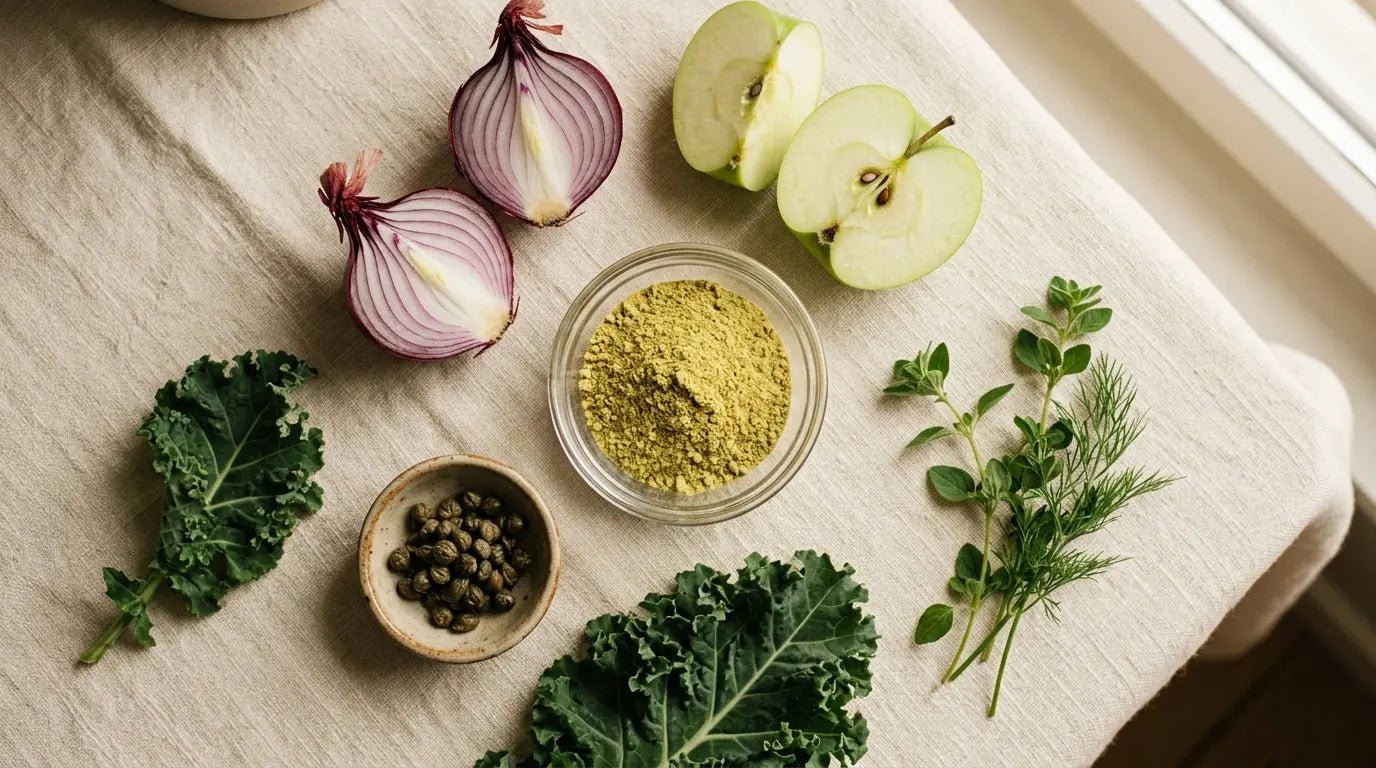
Quercetin is naturally found in onions, capers, apples, berries, kale, and green tea. However, only relatively small amounts are obtained through food, and quercetin is not particularly easily absorbed by the body. This is precisely where a well-thought-out formula makes a difference: it delivers a reliable, standardized amount, ideally combined with substances that work together.
Because quercetin best unfolds its potential as part of a team. Vitamin C is traditionally combined with quercetin, and the interaction with minerals like zinc also makes sense because they are involved in the body's processing of histamine.
The nutrients that support your histamine breakdown
Histamine breakdown is teamwork, and some nutrients are essential for it.
- Copper and Vitamin B6:the body uses both directly as building blocks for the enzyme DAO, which breaks down histamine in the intestine. If they are missing, the enzyme works more slowly.
- Zinc:is involved in countless metabolic processes, contributes to the protection of cells from oxidative stress, and also plays a role in normal hormone balance. This makes it doubly interesting when it comes to histamine and hormones.
- Vitamin C:has long been associated with histamine breakdown and contributes to the normal functioning of the immune system.
You see: It is rarely a single substance, but rather the clever interaction that supports histamine balance.
Eating low-histamine: your cheat sheet
Diet remains the biggest lever. This overview helps you get started but does not replace personal testing, as every woman tolerates things differently.
- Rather high in histamine:aged cheese, salami and sausage, smoked meats, long-stored or smoked fish, sauerkraut and other fermented foods, red wine, beer and sparkling wine, and long-stored meals.
- Rather low in histamine:fresh, quickly processed meat and fish, fresh eggs, most fresh vegetables, rice, potatoes, oats, fresh dairy products like cream cheese, and well-tolerated fruits like apples or blueberries.
- So-called histamine liberators:contain little histamine themselves but stimulate its release or slow down its breakdown, including alcohol, tomatoes, citrus fruits, strawberries, and chocolate.
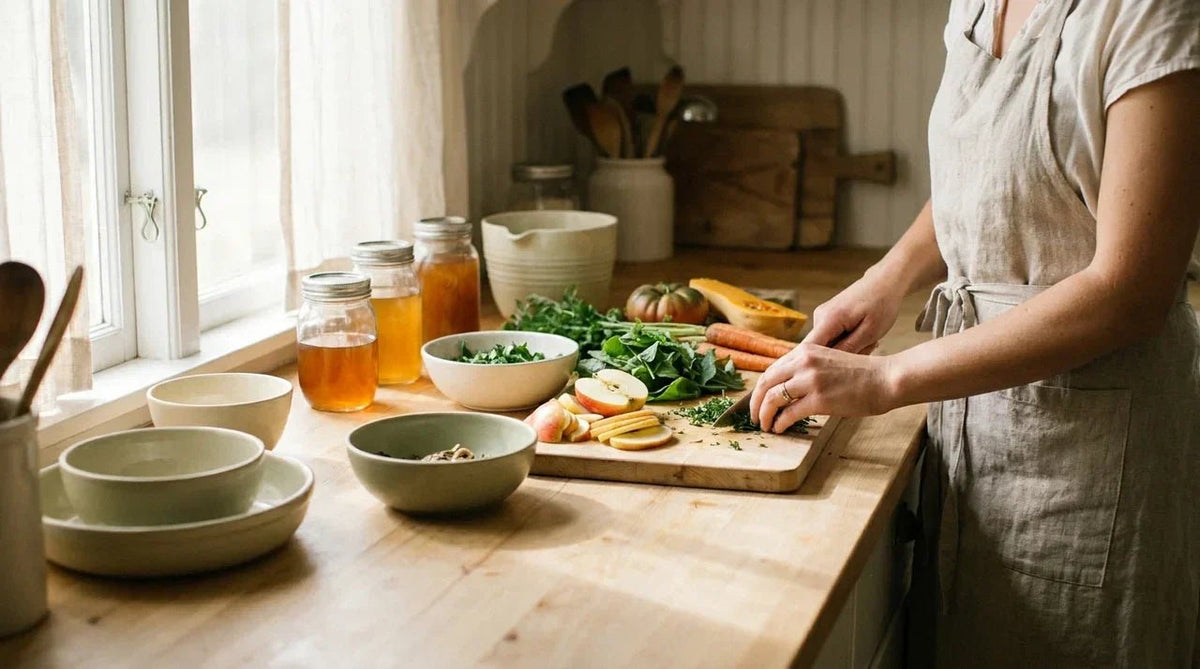
A practical tip: The fresher, the better. Histamine develops during ripening and storage, which is why freshly prepared meals are usually more tolerable than leftovers from the day before.
What else you can do in your daily life
Besides diet, there are a few adjustments that can help alleviate the burden.
- Symptom diary with cycle:Note down complaints together with the cycle day. This way, you'll see in black and white whether your symptoms increase around ovulation or before your period, and you can take targeted countermeasures.
- Alcohol, sleep and stress:Alcohol slows down histamine breakdown and is often high in histamine itself. Chronic stress and too little sleep can also make mast cells more irritable.
- Keep an eye on your gut:Since DAO is produced in the gut, irritated intestinal lining or an imbalance like SIBO can weaken its breakdown. This can be clarified medically.
- Exercise with moderation:Moderate exercise is beneficial, but very intense exertion can temporarily release more histamine in some people. Pay attention to your body.
When you should seek medical clarification
Histamine intolerance is a diagnosis of exclusion; there is no single reliable test. Before you permanently restrict yourself, have your symptoms medically evaluated. It is important to rule out a true allergy and other causes. In case of severe reactions such as shortness of breath, circulatory problems, or swelling in the mouth and throat, this is an emergency and requires immediate medical help. And a very strict diet over a long period can lead to nutrient deficiencies, which is why professional guidance is advisable.
Conclusion
Histamine intolerance is more than a reaction to food. In many women, it has a hormonal rhythm: estrogen drives histamine release and inhibits its breakdown, while progesterone has a balancing effect. Therefore, symptoms often worsen around ovulation, before menstruation, and during menopause.
The good news: You are not at its mercy. With a targeted, time-limited low-histamine diet, well-researched plant compounds like quercetin, and a solid nutrient base that supports histamine breakdown, you have many points of leverage. Consider the whole picture in conjunction with your cycle, and seek medical guidance if symptoms are severe or remain unclear.