


One of the women who particularly stuck in my mind was in her late twenties, ran half marathons, worked a lot, and was proud of being disciplined. Her period had been absent for over a year, and for a long time, she found that convenient. It was only when she started thinking about having children that she realized her body was quietly running on low power. Her story is an example, not an isolated case: behind hypothalamic amenorrhea almost always lies a body that isn't getting enough energy to do everything at once.
This is precisely what makes this topic so important and yet so often misunderstood. A missed period is not a sign of strength or exceptional fitness, but a signal that something is out of balance. The good news first: in most cases, functional hypothalamic amenorrhea is reversible if you give your body back what it lacks.
What is hypothalamic amenorrhea?
Hypothalamic amenorrhea means that menstruation ceases because the hypothalamus temporarily reduces hormonal control of the cycle. The hypothalamus is a small control center in the brain. If it registers that too little energy is available, it first conserves resources by reducing reproductive functions, as these are not critical for short-term survival. Experts refer to it as functional amenorrhea because it is not caused by a tumor or organ damage, but rather by an adaptation to an energy deficit (Gordon et al., 2017).
Three typical triggers are distinguished, which often overlap: insufficient energy intake, excessive exercise, and chronic stress. Essentially, all three boil down to the same thing: insufficient available energy for the body. For a broader overview of all possible reasons why your period might be absent, you can find more information in our article on why your period is absent.
| Trigger | What happens in the body | First step |
|---|---|---|
| Too little energy (eating too little relative to expenditure) | The body detects an energy deficit and reduces GnRH secretion. | Eat regularly and sufficiently, close the energy deficit. |
| Too much exercise (high training volume, little recovery) | High expenditure with insufficient intake creates the same energy deficit. | Reduce training volume and plan for genuine recovery days. |
| Chronic stress (pressure, lack of sleep) | A continuously activated stress axis further inhibits GnRH signals. | Address stress and sleep, and seek support. |

The daily nutrient foundation during your recovery
Hormonic Base provides, among other things, magnesium, vitamin B6, and folate, which, according to the EFSA, contribute to normal energy metabolism and the reduction of fatigue, as well as vitamin D for normal calcium utilization and the maintenance of normal bones. Important and honest: The decisive step is sufficient energy intake and medical supervision. No supplement will bring back your period. Base can only support the basic nutrient supply during recovery.
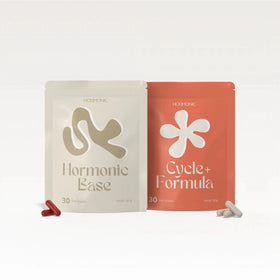
Base provides you with the 16 essential nutrients your body needs daily for key processes like hormone production. Cycle+ adds 8 active ingredients that have been studied for their role in cycle health. Developed by doctors and produced in Austria.
Frequently Asked Questions about Hypothalamic Amenorrhea
What is hypothalamic amenorrhea?
How long does it take for your period to return?
Wie unterscheidet sich FHA von PCOS?
Was kann ich bei hypothalamischer Amenorrhoe selbst tun?
Scientific Sources
- Gordon CM, Ackerman KE, Berga SL, et al. (2017). Functional Hypothalamic Amenorrhea: An Endocrine Society Clinical Practice Guideline. J Clin Endocrinol Metab, 102(5):1413-1439. doi:10.1210/jc.2017-00131
- Mountjoy M, Sundgot-Borgen J, Burke L, et al. (2018). IOC consensus statement on relative energy deficiency in sport (RED-S): 2018 update. Br J Sports Med, 52(11):687-697. doi:10.1136/bjsports-2018-099193
- Pape J, Herbison AE, Leeners B. (2021). Recovery of menses after functional hypothalamic amenorrhoea: if, when and why. Hum Reprod Update, 27(1):130-153. doi:10.1093/humupd/dmaa032
- Phylactou M, Clarke SA, Patel B, et al. (2021). Clinical and biochemical discriminants between functional hypothalamic amenorrhoea (FHA) and polycystic ovary syndrome (PCOS). Clin Endocrinol (Oxf), 95(2):239-252. doi:10.1111/cen.14402
- Grabia M, Perkowski J, Socha K, Markiewicz-Zukowska R. (2024). Female Athlete Triad and Relative Energy Deficiency in Sport (REDs): Nutritional Management. Nutrients, 16(3):359. doi:10.3390/nu16030359
About the Author

You might also be interested in this.

Why does anorexia cause periods to stop? Learn about the hormonal causes of functional hypothalamic amenorrhea and what helps with underweight.

A missed period is no coincidence. Learn about the most common causes, from stress to PCOS, when medical clarification makes sense, and what really helps to get your cycle back.

Do you suspect an estrogen deficiency? This article shows which natural measures actually work according to current studies – starting with the most powerful lever: energy availability. Plus an hon...