

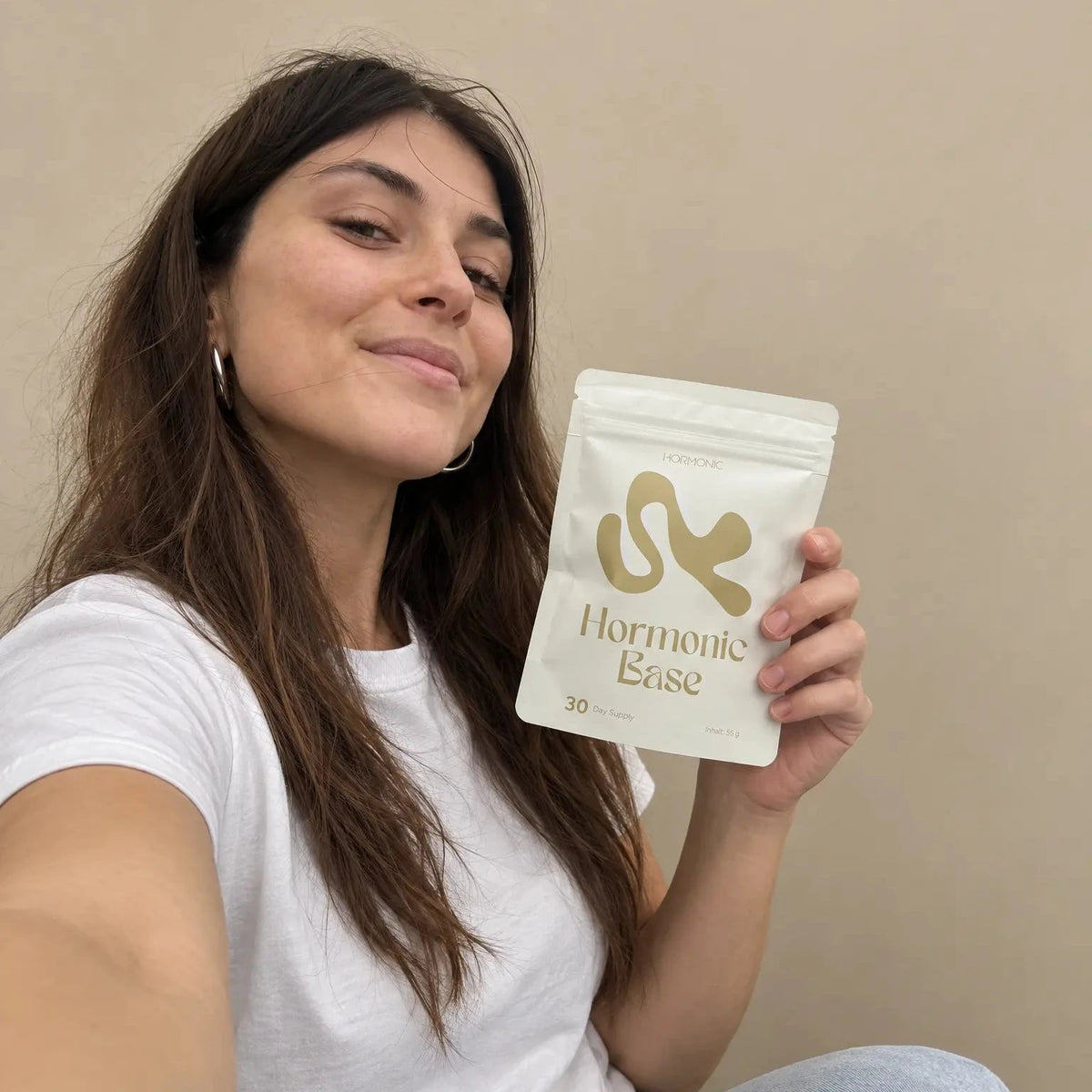
From saffron to magnesium to vitamins D, K2, and creatine: an honest, scientifically classified overview of what can support your body during this phase, and what fails to deliver on its promises.
Direct to the shop: Menopause Supplements – physician-developed, produced in Austria, from €52 with subscription.
Menopause sets a lot in motion: sleep, mood, energy, bones – your whole body changes. And as soon as you start looking, a flood of capsules, powders, and complexes promising to help right now washes over you. The honest truth upfront: no supplement replaces medical treatment, and not every product lives up to its advertising claims. But there are micronutrients and plant compounds that can demonstrably support your body during this phase. Here, we sort them honestly according to what the science truly shows, so you can make informed choices.
Why your body needs more during menopause
During menopause, estrogen levels drop, which affects far more than just the menstrual cycle. Estrogen is involved in bone metabolism, mood, sleep, and energy balance, among other things. When its levels decrease, for example, the risk of bone loss increases, and the need for certain nutrients becomes more prominent. This is precisely where well-considered supplementation comes in: not as a miracle cure, but as support for areas that are particularly challenged at this time.
Briefly explained
Support, not treat
By definition, food supplements are not medicinal products. Vitamins and minerals may be described with legally approved effects, such as vitamin D contributing to the maintenance of normal bones. This is different from a promise of cure. In this overview, we clearly separate the two: proven functions on one hand, honestly classified study evidence on the other.
To help you quickly navigate, here's an honest overview. The evidence column shows how well the respective support is substantiated, from legally recognized functions to still inconsistent study findings.
| Active Ingredient | Supports | Evidence | In Hormonic |
|---|---|---|---|
| Vitamin D3 | Maintenance of normal bones, muscle function, immune system | Strong | Base |
| Vitamin K2 | Maintenance of normal bones | Moderate | Base |
| Magnesium | Nervous system, psyche, energy, reduced fatigue | Strong (function) | Base |
| Vitamin B6 and Folate | Hormonal activity, energy metabolism, psyche | Strong (function) | Base |
| Zinc and Selenium | Cell protection, thyroid, skin and hair | Strong (function) | Base |
| Creatine | Muscle strength with resistance training (from 55 years) | Strong (EU-Claim) | Midlife |
| Saffron extract (affron®) | Studied for emotional balance | Moderate | Midlife |
| Trans-Resveratrol | Studied for cognition and bones | Moderate | Midlife |
| Red clover isoflavones | Plant estrogens, inconsistent study findings | Mixed | Midlife |
| Quercetin | Antioxidant properties (studied) | Preliminary | Midlife |
| Astaxanthin | Skin elasticity (observed in studies) | Moderate | Midlife |
| L-Theanine | Inner calm and sleep quality | Preliminary | Midlife |
| Wild yam | Traditionally used, human evidence weak | Weak | Midlife |
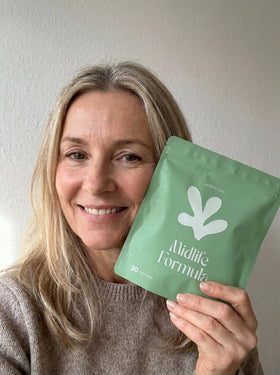
The formula specifically for menopause
Midlife Formula combines active ingredients that are the focus of menopause research, including 40 mg of red clover isoflavones, standardized saffron extract (affron), and trans-resveratrol, in transparent dosages, vegan, and laboratory-tested in Germany.
€75,00
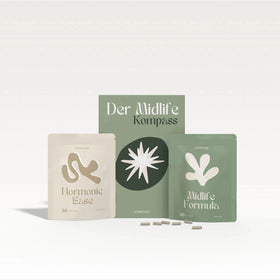
The starter kit for women who want to give their bodies the best
The bundle of Base and Midlife Formula provides you not only with specific plant compounds for menopause but also with the essential active ingredients your body needs daily for hormonal processes: vitamins D, K, zinc, selenium, and 12 more. Plus, a medical guide for an easy start.
Frequent questions about nutritional supplements during menopause
What supplements are useful during menopause?
Do supplements help with hot flashes?
Kann ich Nahrungsergänzung zusätzlich zur Hormontherapie nehmen?
Wie lange dauert es, bis Nahrungsergänzung wirkt?
Scientific Sources
- Kanadys, W. et al. (2021). Evaluation of clinical meaningfulness of red clover extract to relieve hot flushes and menopausal symptoms in peri- and post-menopausal women: a systematic review and meta-analysis of RCTs. Nutrients. doi:10.3390/nu13041258
- Lambert, M. N. T. et al. (2017). Combined red clover isoflavones and probiotics potently reduce menopausal vasomotor symptoms. PLoS One. doi:10.1371/journal.pone.0176590
- Lethaby, A. et al. (2013). Phytoestrogens for menopausal vasomotor symptoms. Cochrane Database Syst Rev. doi:10.1002/14651858.CD001395.pub4
- Lopresti, A. L. et al. (2021). Effects of saffron on menopausal symptoms in perimenopausal women: a randomised controlled trial. J Menopausal Med. doi:10.6118/jmm.21002
- Thaung Zaw, J. J. et al. (2021). Long-term effects of resveratrol on cognition and cerebrovascular function in postmenopausal women (RESHAW). Clin Nutr. doi:10.1016/j.clnu.2020.08.025
- Wong, R. H. X. et al. (2020). Regular supplementation with resveratrol improves bone mineral density in postmenopausal women. J Bone Miner Res. doi:10.1002/jbmr.4115
- Boyle, N. B., Lawton, C. & Dye, L. (2017). The effects of magnesium supplementation on subjective anxiety and stress. Nutrients. doi:10.3390/nu9050429
- Hidese, S. et al. (2019). Effects of L-theanine administration on stress-related symptoms and cognitive functions. Nutrients. doi:10.3390/nu11102362
- Ma, M. L. et al. (2022). Efficacy of vitamin K2 in postmenopausal osteoporosis: a meta-analysis. Front Public Health. doi:10.3389/fpubh.2022.979649
- The Menopause Society (2023). The 2023 nonhormone therapy position statement. Menopause. PMID: 37252752
- Komesaroff, P. A. et al. (2001). Effects of wild yam extract on menopausal symptoms, lipids and sex hormones in healthy menopausal women. Climacteric. doi:10.1080/713605087
- Smith-Ryan, A. E. et al. (2021). Creatine supplementation in women's health: a lifespan perspective. Nutrients. doi:10.3390/nu13030877
- Serban, M.-C. et al. (2016). Effects of quercetin on blood pressure: a systematic review and meta-analysis of randomized controlled trials. J Am Heart Assoc. doi:10.1161/JAHA.115.002713
- Zhou, X. et al. (2021). Effects of astaxanthin supplementation on skin health: a systematic review and meta-analysis of randomized controlled trials. Nutrients. doi:10.3390/nu13092917
- Commission Regulation (EU) 2017/672 authorising a health claim on creatine and muscle function in adults over 55 in conjunction with resistance training. Off J Eur Union.
About the Author

You might also be interested in this.

Magnesium can support sleep, mood, and bones in perimenopause and postmenopause. Here's what the research actually says, which forms work best, and what magnesium can't do.
Creatine in Menopause: What studies really show about muscle strength and bones, how much makes sense, and why combining it with training matters.
What helps with hot flashes, mood swings, or trouble sleeping? Studies show these plant-based compounds can support you through menopause.