



When the desire for sex wanes, many women feel worried or guilty. Yet, this is common, often harmless, and rarely solely a hormonal problem. This article honestly explains what lies behind loss of libido and what really helps.
Key takeaways
- About one in three women experience low desire temporarily, but only about one in ten truly suffer from it. It's this suffering that makes it an issue.
- Female desire is often reactive, not spontaneous. It frequently arises only with the right situation and intimacy, not out of nowhere.
- There is rarely a single cause. The most important factors are relationship, psyche, stress, and exhaustion, often also medication.
- Antidepressants and, in some cases, the pill can dampen desire. Hormone levels alone, however, hardly explain loss of libido in young women.
- Addressing the root cause and discussions or sex therapy help the most. No dietary supplement reliably increases desire.
In my consultations, I often experience how distressing this topic is and how much shame accompanies it. Therefore, I first want to ease your worries: declining desire is common and usually not a sign that something is fundamentally wrong with you. I want to calmly and honestly explain what might be behind it and what actually helps, without pathologizing you.
Did you know?
Many women do not experience desire spontaneously out of nowhere, but reactively: they start neutrally and only get in the mood through intimacy, touch, and the right situation. Waiting for spontaneous desire and interpreting its absence as a disorder, therefore, often misses the point of normal female sexuality.
First of all: What is actually normal?
Desire fluctuates, and that applies to everyone. Throughout the cycle, during periods of stress, in a long-term relationship, after childbirth: it is completely normal for desire to be stronger or weaker at times. Surveys show that about one in three women report temporarily low desire, but only about one in ten truly suffer from it. It is precisely this distress that is the crucial boundary: low desire only becomes a treatable issue if it burdens you or your relationship, not because a certain frequency is not met.
It is also important to understand how female desire works. It is often reactive rather than spontaneous. This means: it is not the sudden urge that comes first, but often the willingness to engage, and from that, desire then arises. Knowing this reduces self-imposed pressure.
Why desire wanes
And now the most important point: there is rarely one single cause. Usually, several factors interact, and the most common ones are not hormones:
- Relationship and psyche. Relationship satisfaction, unresolved conflicts, body image, and past experiences are often the strongest influences, stronger than any hormone level.
- Stress, exhaustion, and sleep. Those who are constantly under pressure, mentally overloaded, and tired simply have little capacity for desire. This is understandable, not a defect.
- Medication. Especially SSRI-type antidepressants often dampen desire in many people. The birth control pill can also play a role because it lowers free testosterone, although its effect on desire varies from woman to woman. You can read more about this in the article on stopping the pill.
- Pain and dryness. If sex hurts, for example due to vaginal dryness, avoidance often follows, leading to a secondary loss of desire.
- Hormonal and physical factors. Honestly: in young women, desire is only weakly dependent on testosterone levels, so a low level rarely explains it alone. A thyroid disorder, elevated prolactin, the time after childbirth, and breastfeeding, however, can significantly dampen desire.
For you, this primarily means: loss of libido is almost never just a hormone issue, but a combination of factors. That's precisely why there isn't one magic pill, but rather an honest look at the whole picture.
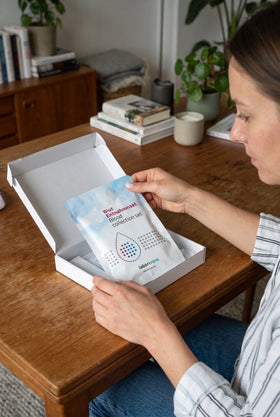
Hormone Diagnostics Kit: for sudden loss of libido
If your libido suddenly drops and other complaints arise, it's worth checking values like your thyroid and prolactin. With the Hormonic Diagnostics Kit, you can conveniently measure important hormone and metabolic levels from home, analyzed by a leading German laboratory. This way, you get a solid basis instead of guessing in the dark.
€289,00

Does your loss of libido bother you?
Don't know where to start when your libido is declining, or are you worried about other complaints? In a free 15-minute consultation, one of our doctors will assess your situation, with no obligation.
Common Questions About Loss of Libido in Women
Is loss of libido normal in women?
What are the most common causes of loss of libido?
Welche Nährstoffe oder Mittel steigern die Libido?
Wann sollte ich mit Libidoverlust zur Ärztin?
Scientific Sources
- Shifren, J. L. et al. (2008). Sexual problems and distress in United States women (PRESIDE). Obstet Gynecol, 112(5), 970-978. PMID: 18978095
- Basson, R. (2001). Female sexual response: the role of drugs in the management of sexual dysfunction. Obstet Gynecol, 98(2), 350-353.
- Reed, B. G. et al. (2016). Testosterone and female sexual dysfunction: a systematic review. Int J Womens Health, 8, 599-607. PMID: 27785108
- Zimmerman, Y. et al. (2014). The effect of combined oral contraception on testosterone levels in healthy women: a systematic review and meta-analysis. Hum Reprod Update, 20(1), 76-105. PMID: 24082040
- Jaspers, L. et al. (2016). Efficacy and safety of flibanserin for the treatment of HSDD in women: a systematic review and meta-analysis. JAMA Intern Med, 176(4), 453-462. PMID: 26927498
- Brotto, L. A., Basson, R. (2014). Group mindfulness-based therapy improves sexual desire in women. Behav Res Ther, 57, 43-54.
- Shin, B. C. et al. (2010). Maca for improving sexual function: a systematic review. BMC Complement Altern Med, 10, 44. PMID: 20691074
- Regulation (EU) No 432/2012; EFSA Journal 2009 (Zinc: normal testosterone levels in the blood, normal fertility and reproduction).
About the Author

You might also be interested in this.

When intimacy suddenly becomes bone dry, many women feel alone. But vaginal dryness and loss of libido during menopause are common – and treatable. This guide shows you why your body is changing an...

Fatigue, loss of libido, muscle weakness? Learn how to recognize testosterone deficiency in women – with information on causes and typical symptoms.

Are you considering discontinuing the pill, or have you already done so? This guide provides evidence-based information on what happens in your body, typical side effects and symptoms, and how long...