Offer ends in10:00

Cart

Your cart is empty

Continue shopping

Trending searches

Featured products

Hormonic Base - Hormonic - Nahrungsergänzungsmittel
Sale price€65,00
(5.0)
Midlife Formula - Hormonic - Nahrungsergänzungsmittel
Sale price€75,00
(5.0)
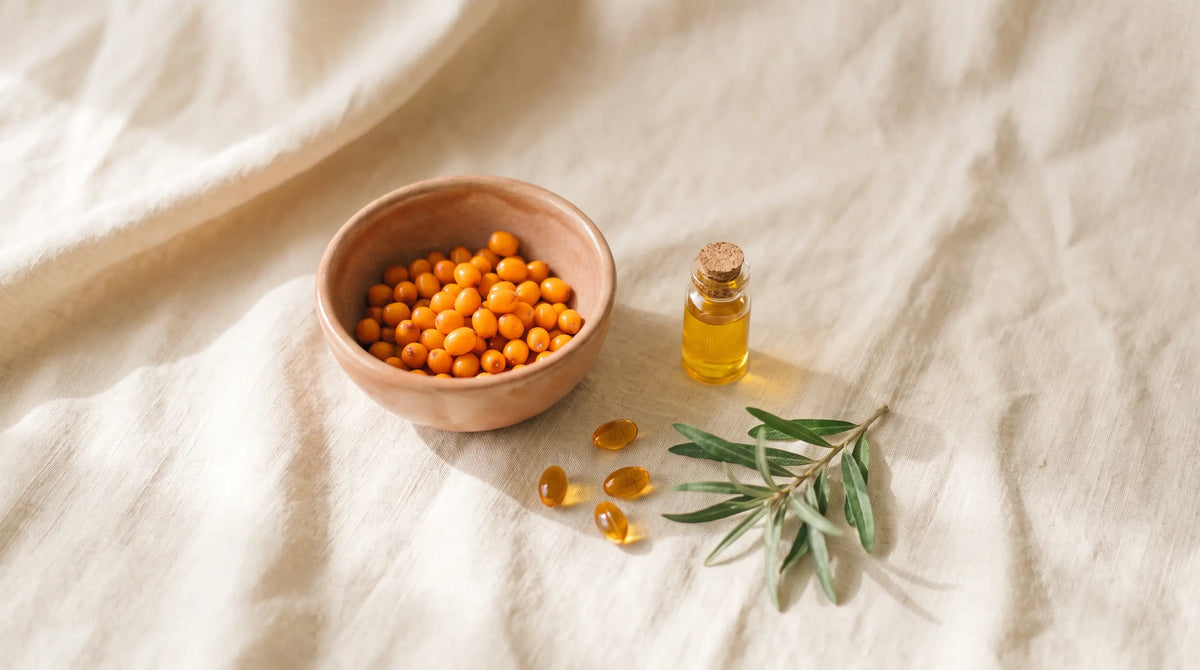
Sanddornbeeren, Öl und Kapseln auf Leinen als natürliche Mittel und Hausmittel gegen Scheidentrockenheit
WechseljahreOct 3, 20267 min read

Vaginal dryness: An honest review of home remedies and natural treatments

This article is part of: Perimenopause and Menopause: The Complete Medical Guide

When I researched the recommendations women receive for vaginal dryness for this article, I was honestly stunned: yogurt on a tampon, tea tree oil, douches with diluted vinegar. Advice that is about as helpful on a sore, thin mucous membrane as lemon juice on chapped lips.

Yet there are indeed natural remedies backed by real studies. It’s just that they are different from the ones circulating online. Here is the honest check: what helps according to research, what is unproven, and what you should steer clear of.

Overview: Checking home remedies and natural treatments

The table summarizes how the most important over-the-counter treatments perform in research. Below, we look at the most interesting ones in detail.

Treatment What research shows Evidence base Useful?
Moisturizing gel First choice according to guidelines Well-supported Yes, as a baseline
Vaginal hyaluronic acid Studies show similar effectiveness to local estrogen Well-supported Yes
Vaginal vitamin E Positive randomized studies Initial studies Worth a try
Oral sea buckthorn oil One positive placebo-controlled study Initial studies Worth a try
Red clover and soy Conflicting study results Mixed No impact expected on mucosa
Oral vitamin D Randomized study shows no clear benefit Mixed Not specifically for this
Yogurt tampon No studies, risk of infection None No
Tea tree oil Irritates the mucosa None No
Coconut oil No studies, damages condoms None Use with caution at most

Our main article on Vaginal dryness: causes, symptoms and what really helps explains why the mucous membrane becomes dry in the first place and what role estrogen plays in this.
These natural remedies have genuine studies to support them

Direct answer: Hormone-free moisturizing gels and vaginal hyaluronic acid are best supported, followed by sea buckthorn oil and vitamin E, which have preliminary randomized studies. Read here to see exactly what the research shows.

Moisturizing gels: unspectacular, but the first choice

They sound like the most boring tip on the list, but they are the most effective over-the-counter option: Hormone-free moisturizing gels, used regularly two to three times a week, improve the moisture and elasticity of the mucous membrane and are cited by the S3 guideline on peri- and postmenopause as the first non-hormonal measure. The difference to lubricant: A moisturizing gel provides long-term care, while lubricant helps situationally during sex. Both can be combined.

Hyaluronic acid: the best-researched hormone-free remedy

You may know hyaluronic acid from facial care; it binds many times its weight in water. When used as a vaginal gel or suppository, it showed an alleviation of dryness symptoms in a systematic review that was comparable in several studies to that of local estrogen (dos Santos et al., 2021). For an over-the-counter, hormone-free remedy, that is remarkable. Look for products specifically for the vaginal mucosa, without perfume.

Sea buckthorn oil: the most interesting oral option

Sea buckthorn is rich in rare omega-7 fatty acids, which are a building block of skin and mucous membranes. In a randomized, placebo-controlled study with 116 postmenopausal women, the daily intake of 3 grams of sea buckthorn oil over three months improved the integrity of the vaginal mucosa compared to placebo (Larmo et al., 2014). This is the only study of its kind to date, so the interpretation remains cautious: a plausible, mild effect from the inside, but not a replacement for local care.

Vitamin E: studied as a suppository, not as a capsule

Vaginal vitamin E suppositories improved the symptoms of the genitourinary syndrome of menopause in a randomized controlled study (Golmakani et al., 2019). Important for context: The local application in the vagina was studied, not vitamin E capsules for swallowing. Those who would like to try it can find corresponding preparations at the pharmacy.

Vitamin D: mixed data

Because the vaginal mucosa has vitamin D receptors, there was hope that supplementation would help. However, a randomized study with postmenopausal women found no clear advantage of oral vitamin D over placebo for vaginal atrophy (Kamronrithisorn et al., 2020). A good vitamin D status remains sensible for other reasons, such as for bones and the immune system, but you should not plan on it as a targeted remedy for dryness.

Linseed oil and other ingestible oils: popular, but poorly supported

Linseed oil is often touted online as an insider tip for a dry vagina, usually with reference to its omega-3 fatty acids. There are no targeted studies on the vaginal mucosa for this. The detour via general supply is more plausible: anyone who eats a very low-fat diet in the long term absorbs too few essential fatty acids, and this can also manifest in the skin and mucous membranes. So, a tablespoon of linseed oil in quark doesn't hurt, but you shouldn't expect a targeted effect on the vagina. The only oral oil option with its own placebo-controlled study on the vaginal mucosa remains sea buckthorn oil.

Phytoestrogens: an honest look at red clover and soy

Phytoestrogens like the isoflavones from red clover and soy are structurally similar to estrogen and bind preferentially to one of its receptor types. For the vaginal mucosa, the state of the evidence is contradictory: one study with red clover isoflavones observed positive effects on mucosal status and skin appearance (Lipovac et al., 2011), while a placebo-controlled study on the vagina found no effect at all from isoflavones (Nikander et al., 2005). Honestly summarized: For hot flashes, the data on red clover is significantly better than for the mucosa. If you take isoflavones, do it for the big picture of menopause, not as a targeted remedy for dryness.

This explicitly does not mean that herbal support is unimportant; on the contrary: in a phase where the entire body is reacting to the missing estrogen, well-dosed plant substances are among the few levers you have in your own hands. Their starting point is just different: better sleep, more stable mood, more energy. And it is precisely these levels that indirectly influence the topic of this article, because relaxation and arousal are the natural way in which the mucosa becomes moist during sex.

In case you are wondering where such plant substances are appropriately classified: Our article on herbal remedies during menopausesorts the evidence from red clover to black cohosh.

Midlife Formula: Plant compounds, properly classified

If you want to rely on plant-based substances, do it with the right dosage rather than as a kitchen experiment: The Midlife Formula provides red clover isoflavones, studied primarily for hot flashes, saffron and L-theanine from mood and relaxation research, and creatine for energy metabolism. This allows you to support menopause from within, with indirect effects on sleep, mood, and energy, while moisture and hyaluron do their work on the mucous membranes.

Discover Midlife Formula

Hands off: These home remedies do more harm than good

Short and clear: Anything that goes into an irritated vagina that doesn’t belong there makes things worse. This particularly applies to three classics from internet forums.

  • Yogurt tampons: The idea sounds logical: introduce lactic acid bacteria from the outside. But food-grade yogurt contains the wrong bacterial strains, often sugar, and zero germ control. There are no studies on its effectiveness, but there is an infection risk.
  • Tea tree oil and other essential oils: Highly concentrated essential oils are strong irritants and contact allergens. On thin, sore mucous membranes, they can significantly intensify burning and inflammation.
  • Vinegar or chamomile douches: Vaginal douches of any kind disrupt the flora and wash away the very protective film that a dry mucous membrane still has. The vagina cleans itself, even during menopause.

Coconut oil is a special case: At least it is mild and is perceived by some women as a substitute for lubricant. However, studies on vaginal application are lacking; it can disrupt the pH balance and flora, and it makes latex condoms permeable. If contraception with a condom is an issue for you, it is ruled out.

The right foundation: Everyday life and nutrients

Home remedies work best on a reasonable foundation: gentle care only with water or mild, unperfumed washing lotions, cotton underwear, drinking enough, and, if you smoke, a serious look at quitting, because smoking measurably impairs the blood circulation of the mucous membranes.

If your dryness is part of menopause, you can additionally support the big picture from within. Many women rely on a combination of daily basic care and a menopause complex, such as the Midlife Bundle: It combines the Hormonic Base, which provides 16 micronutrients including vitamin D3, zinc, and a magnesium complex of bisglycinate, malate, and citrate, with the Midlife Formula and its 9 plant substances, including red clover isoflavones, saffron, and creatine—a total of 25 active ingredients. Zinc contributes to the maintenance of normal skin, magnesium and vitamin B6 to the reduction of fatigue, and the isoflavone question is thus cleanly resolved: as a companion for the entire phase of life, not as a promise of dryness relief for the mucous membrane.

And one more practical piece of advice from research: always test only one remedy at a time and give it four to six weeks, because that is how long the studies needed to show effects. Anyone who starts three things at once will not know in the end what helped, and anyone who switches after a week gives an effective remedy no chance.

When home remedies are no longer enough

Give a well-chosen remedy four to six weeks. If nothing has improved by then, pain during sex persists, or bleeding, severe itching, or noticeable discharge is added, then the experiments must end: then the cause must be clarified by a doctor. The most effective treatment for pronounced vaginal dryness is and remains low-dose local estrogen, which rebuilds the mucous membrane and only minimally enters the bloodstream.

If you are unsure whether your symptoms are hormonal and which path is right for you: In a free 15-minute initial consultationyou can discuss your situation with one of our doctors, without obligation and without a waiting room.

Unsure if your symptoms are hormonal?

Before you try out home remedies: In a free 15-minute consultation, one of our doctors will provide an initial assessment of whether an estrogen deficiency could be the cause and which steps make sense, completely without obligation.

Secure your free initial consultation

Conclusion

The honest assessment: The most effective "home remedies" for vaginal dryness are the straightforward ones from the pharmacy, moisturizing gel and vaginal hyaluronic acid. Sea buckthorn oil and vitamin E suppositories are interesting natural supplements with preliminary studies, while phytoestrogens belong more to the big picture of menopause than to the mucous membrane.

Yogurt, tea tree oil, and douches, on the other hand, cost you time and, in case of doubt, your mucous membrane. And if the over-the-counter options are not enough after a few weeks, that is not a failure, but a signal for the next step: a medical consultation and, if necessary, local estrogen.

Frequently asked questions about home remedies for vaginal dryness

Which home remedy provides immediate relief for vaginal dryness?

The fastest acting solutions are a lubricant for sex and a hormone-free moisturizing gel for daily care, both available over-the-counter from pharmacies or drugstores. True kitchen home remedies like yogurt or oils from the pantry, on the other hand, have not been studied and often further irritate the mucous membrane.

Is yogurt a good home remedy for vaginal dryness?

No. Yogurt contains the wrong bacterial strains for the vaginal flora, often includes sugar, and is not sterile. There are no studies showing it benefits vaginal dryness, but a real risk of promoting irritation and infections. Better: a moisturizing gel or hyaluronic acid suppositories from the pharmacy.

Kann ich Östrogenmangel in der Scheide natürlich behandeln?
Teilweise. Hormonfreie Befeuchtungsgele und vaginale Hyaluronsäure lindern die Beschwerden gut, ohne Hormone zuzuführen. Den Östrogenmangel selbst beheben sie aber nicht. Wenn die Schleimhaut stark zurückgebildet ist, bleibt niedrig dosiertes lokales Östrogen die wirksamste Behandlung, verschrieben und begleitet von Deiner Ärztin oder Deinem Arzt.
Welche Vitamine helfen bei Scheidentrockenheit?
Am besten untersucht ist Vitamin E, allerdings als Vaginalzäpfchen, nicht als Kapsel zum Schlucken. Für orales Vitamin D fand eine randomisierte Studie keinen klaren Vorteil für die Schleimhaut. Interessant ist außerdem Sanddornöl mit seinen Omega-7-Fettsäuren, das in einer placebokontrollierten Studie die Schleimhautintegrität verbesserte.

Scientific Sources

  • dos Santos CCM et al. (2021). Hyaluronic Acid in Postmenopause Vaginal Atrophy: A Systematic Review. The Journal of Sexual Medicine. doi:10.1016/j.jsxm.2020.10.016
  • Larmo PS et al. (2014). Effects of sea buckthorn oil intake on vaginal atrophy in postmenopausal women: a randomized, double-blind, placebo-controlled study. Maturitas. doi:10.1016/j.maturitas.2014.07.010
  • Golmakani N et al. (2019). Vitamin E as alternative local treatment in genitourinary syndrome of menopause: a randomized controlled trial. International Urogynecology Journal. doi:10.1007/s00192-018-3698-z
  • Kamronrithisorn T et al. (2020). Effect of Vitamin D Supplement on Vulvovaginal Atrophy of the Menopause. Nutrients. doi:10.3390/nu12092876
  • Lipovac M et al. (2011). Effect of Red Clover Isoflavones over Skin, Appendages, and Mucosal Status in Postmenopausal Women. Obstetrics and Gynecology International. doi:10.1155/2011/949302
  • Nikander E et al. (2005). Lack of effect of isoflavonoids on the vagina and endometrium in postmenopausal women. Fertility and Sterility. doi:10.1016/j.fertnstert.2004.09.003
  • S3 Guideline on Peri- and Postmenopause, Diagnosis and Interventions. AWMF Registry Number 015-062.

About the Author

Amelie Weiss

Amelie Weiss

Research Fellow, PhD · Hormonic

Amelie Weiss is a Research Fellow at Hormonic and conducts scientific research on hormonal health, micronutrients, and evidence-based women's health.

Note: This article is based on current guidelines and scientific work (as of 2026). It is for informational purposes only and does not replace medical advice, diagnosis, or treatment.

Share

You might also be interested in this.
Hausmittel in den Wechseljahren: Was wirklich hilft - Hormonic
WechseljahreSep 13, 20266 min read
Home remedies for menopause: What really helps

Brief Definition Home remedies for menopause are simple everyday measures related to diet, exercise, and household medicine that aim to alleviate typical symptoms. While they do not compensate f...
Pflanzliche Mittel in den Wechseljahren: Was wirklich hilft - Hormonic
WechseljahreNov 16, 20256 min read
Plant compounds during menopause

What helps with hot flashes, mood swings, or trouble sleeping? Studies show these plant-based compounds can support you through menopause.

Östrogenmangel – Was hilft wirklich? Natürliche Maßnahmen im Überblick - Hormonic
HormoneFeb 26, 20269 min read
Estrogen Deficiency – What Really Helps? A Summary of Natural Measures

Do you suspect an estrogen deficiency? This article shows which natural measures actually work according to current studies – starting with the most powerful lever: energy availability. Plus an hon...