

In my office, I often see women who have lived for years with irregular cycles, skin problems, and the quiet feeling that something isn't right. One of them, let's call her Mara, had seen three doctors before her first clear diagnosis and was repeatedly prescribed the pill, without anyone interpreting her values in context. When we finally approached her PCOS diagnosis systematically, she asked me the question almost everyone asks: How is PCOS actually diagnosed, and why did it take so long?
The short answer: PCOS is not proven by a single value, but by the Rotterdam criteria, meaning at least two of three features, combined with the exclusion of other diseases. We will now look at this procedure step-by-step, so you are well prepared for your own appointment.
How is PCOS diagnosed?
PCOS is diagnosed according to the Rotterdam criteria: at least two of three features must be present, and other causes with similar symptoms must be excluded. The three features are menstrual cycle disturbance, hyperandrogenism, and polycystic ovarian morphology on ultrasound or, since 2023, an elevated AMH level.
| Rotterdam Criterion | What it means | How it is determined |
|---|---|---|
| Menstrual Cycle Disturbance (Oligo- or Anovulation) | Rare, irregular, or absent ovulations | Cycle history, absent or irregular bleeding |
| Hyperandrogenism | Too many male hormones, clinically or in the blood | Visible signs like acne or hirsutism and/or elevated androgen markers |
| Polycystic Ovaries or Elevated AMH | Many small follicles in the ovary, alternatively a high AMH level since 2023 | Transvaginal ultrasound (over 20 follicles per ovary) or AMH in adults |
If a menstrual cycle disturbance and hyperandrogenism are already present, ultrasound or AMH are no longer strictly necessary for diagnosis. In the following sections, we will go through each of these components in detail, from hormone markers to ultrasound to the exclusion of other causes.

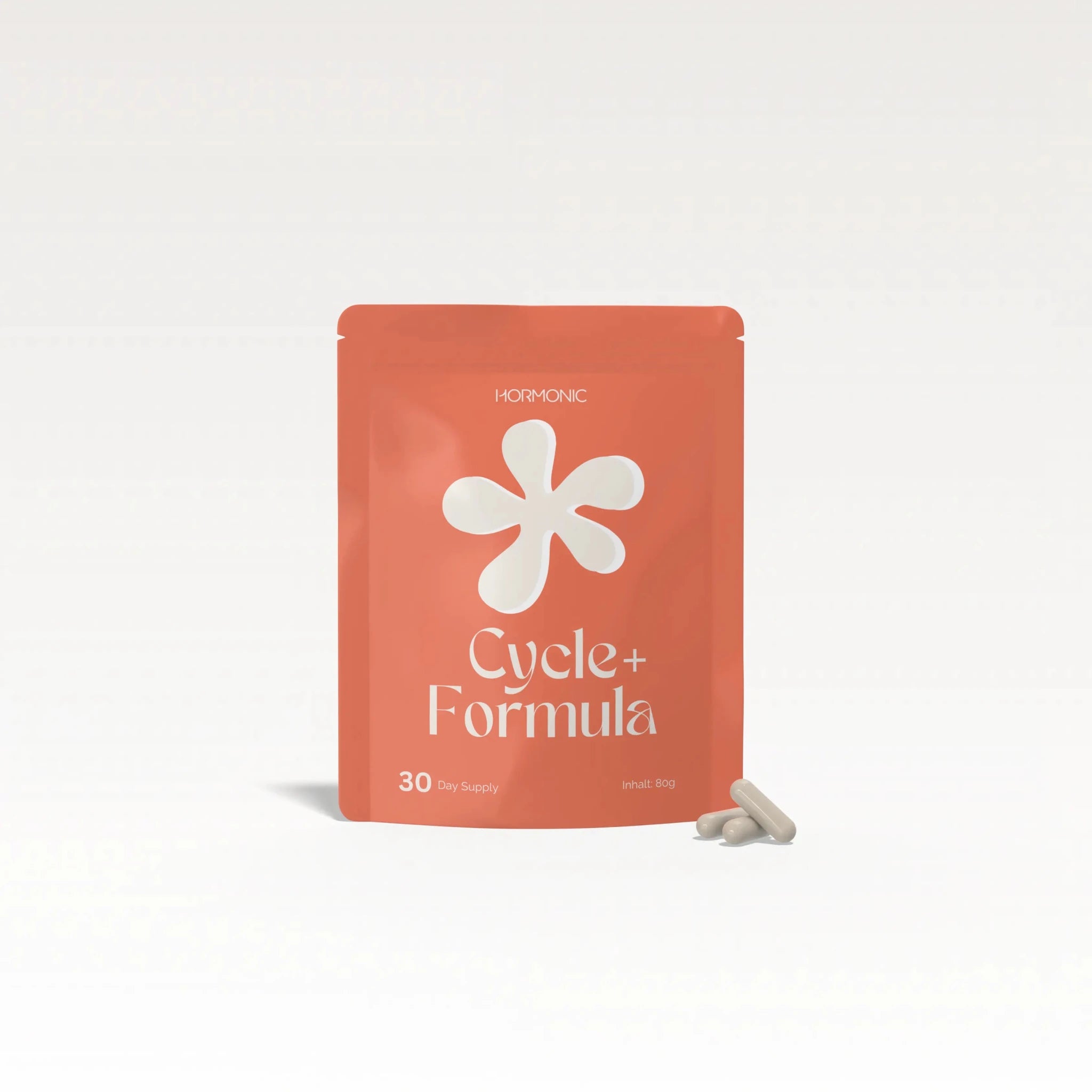
Cycle+ Formula: Support for Insulin and Androgens
In PCOS, insulin and androgens are closely linked, and this is exactly where Cycle+ comes in. The formula combines Myo- and D-chiro-inositol with zinc: Studies have observed that inositol can support insulin sensitivity and the likelihood of a regular cycle (Greff et al., 2023), even if the overall evidence is still limited (Fitz et al., 2024). According to the EFSA, zinc contributes to normal fertility and reproduction and to the protection of cells from oxidative stress. Developed as a supplement to your medical evaluation, not a replacement.

Unsure if your symptoms are due to PCOS?
You don't have to sort this out alone. In a free 15-minute intro call, you can ask our wellness team all your questions, with no obligation. Conveniently from home, with no annoying waiting times.
Frequent Questions About PCOS Diagnosis
Which hormone markers indicate PCOS?
Can PCOS be seen on an ultrasound?
How reliable is a PCOS diagnosis?
Can PCOS be present despite normal hormone markers?
Scientific Sources
- Teede HJ et al. (2023). Recommendations from the 2023 International Evidence-based Guideline for the Assessment and Management of Polycystic Ovary Syndrome. J Clin Endocrinol Metab. 108(10):2447-2469. doi:10.1210/clinem/dgad463
- German Society of Endocrinology (2025). S2k Guideline: Diagnostics and Therapy of Polycystic Ovary Syndrome (PCOS). AWMF Register No. 089-004.
- Gibson-Helm M et al. (2017). Delayed Diagnosis and a Lack of Information Associated With Dissatisfaction in Women With Polycystic Ovary Syndrome. J Clin Endocrinol Metab. 102(2):604-612. doi:10.1210/jc.2016-2963
- Greff D et al. (2023). Inositol is an effective and safe treatment in polycystic ovary syndrome: a systematic review and meta-analysis of randomized controlled trials. Reprod Biol Endocrinol. 21:10. doi:10.1186/s12958-023-01055-z
- Fitz V et al. (2024). Inositol for Polycystic Ovary Syndrome: A Systematic Review and Meta-analysis to Inform the 2023 Update of the International Evidence-based PCOS Guidelines. J Clin Endocrinol Metab. 109(6):1630-1655. doi:10.1210/clinem/dgad762
- World Health Organization (2025). Polycystic ovary syndrome. WHO Fact Sheet. https://www.who.int/news-room/fact-sheets/detail/polycystic-ovary-syndrome
- van der Ham K et al. (2024). Anti-Müllerian hormone as a diagnostic biomarker for polycystic ovary syndrome and polycystic ovarian morphology: a systematic review and meta-analysis. Fertil Steril. 122(4):727-739. doi:10.1016/j.fertnstert.2024.05.163
- Jamilian M et al. (2016). Effects of Zinc Supplementation on Endocrine Outcomes in Women with Polycystic Ovary Syndrome: a Randomized, Double-Blind, Placebo-Controlled Trial. Biol Trace Elem Res. 170(2):271-278. doi:10.1007/s12011-015-0480-7
- Taslim NA et al. (2024). The Effect of Zinc Supplementation on Endocrine Parameters and Hormonal Profiles in Women Diagnosed With Polycystic Ovary Syndrome: A Systematic Review and Meta-Analysis. Curr Dev Nutr. doi:10.1016/j.cdnut.2024.103758
About the Author

You might also be interested in this.

PCOS cannot be cured by diet alone, but nutrition is one of the most effective levers. This evidence-based guide shows which foods stabilize blood sugar, reduce inflammation, and support ovulation.
Which supplements for PCOS are genuinely researched? Inositol, Berberine, NAC & Co. categorized according to scientific studies, honestly and without promises of a cure.

How does inositol work for PCOS, what do studies show regarding ovulation, testosterone, and insulin resistance, and what is a sensible dosage? The evidence-based overview.