


In short: Red clover contains isoflavones, plant compounds that bind weakly to estrogen receptors, and is one of the most thoroughly studied herbal remedies for menopausal hot flashes. A meta-analysis of eight randomized trials involving over 1,000 women observed an average reduction of about 1.7 hot flashes per day, with a reduction of about 2.6 in women experiencing five or more hot flashes daily (Kanadys et al., 2021).
The figure that surprised me most about red clover is not its efficacy, but the variance. In some studies, hot flashes decreased significantly, while in others, they decreased hardly more than with a placebo, and this was with very similar preparations. For a long time, this was considered evidence that red clover "doesn't really" work.
When you look closer, a different picture emerges. Whether red clover has an effect during menopause apparently depends heavily on how frequent the hot flashes are, whether you have already gone through menopause, and even on which bacteria live in your gut. In this article, I will show you what the studies are actually measuring, for whom red clover is suitable, when you should avoid it, and how to identify a good red clover preparation.
How does red clover work during menopause?
Red clover works through its isoflavones, which bind to estrogen receptors in the body—preferentially the beta receptor type—where they act much more weakly than the body's own estrogen. According to the common explanation, when estrogen levels drop during menopause, they can buffer some of these signals.
The most important isoflavones in red clover are formononetin and biochanin A. Your body converts them into daidzein and genistein, the two isoflavones also known from soy (Kanadys et al., 2021). Daidzein can be further converted into equol by certain gut bacteria. Whether you belong to the so-called equol producers depends on your gut flora, which could explain why results vary so much in studies.
Important context: Isoflavones are not hormone replacement therapy. In a twelve-month study, they did not change the thickness of the uterine lining or the levels of estradiol, FSH, or LH (Geller et al., 2009). They therefore act much more gently and differently than hormone replacement therapy.
What do studies on red clover and hot flashes show?
Studies on red clover and hot flashes show a moderate effect: on average, there were about 1.7 fewer hot flashes per day with red clover isoflavones than with a placebo (Kanadys et al., 2021). How much benefit you receive depends heavily on how frequent your hot flashes are.
The most recent meta-analysis evaluated eight randomized studies with 1,043 women. In postmenopausal women, the number of hot flashes dropped by about 2.7 per day; for women with at least five hot flashes daily, it was about 2.6. An older analysis of a standardized extract with 80 mg of isoflavones even found 3.6 fewer hot flashes per day, though this was based on only three small studies (Myers and Vigar, 2017).
To be honest, not all studies were positive. In two large independent studies, red clover did not clearly differ from placebo after twelve weeks or twelve months, respectively (Tice et al., 2003; Geller et al., 2009), and the 2013 Cochrane review found no significant effect for red clover alone (Lethaby et al., 2013). What is striking is how strong the placebo effect is in this area: depending on the study, hot flashes also decreased by up to 59 percent with a dummy preparation.
| Study | Scope | Isoflavones per day | Hot flashes |
|---|---|---|---|
| Kanadys et al., 2021 | Meta-analysis, 8 studies, 1,043 women | 37 to 160 mg, mostly 40 to 80 mg | about 1.7 fewer per day |
| Myers and Vigar, 2017 | Meta-analysis, 3 studies | 80 mg | about 3.6 fewer per day |
| Lambert et al., 2017 | 62 women, 12 weeks | 34 mg, fermented, with probiotics | about 4.3 fewer per day measured |
| Lethaby et al., 2013 | Cochrane review, 5 red clover studies | varying | no significant difference |
| Tice et al., 2003 | 252 women, 12 weeks | 57 and 82 mg | no clinically relevant difference |
What can we conclude from this? Red clover is not a solution for every woman. However, for women with frequent hot flashes who do not wish to take hormones, it is one of the better-studied herbal options, provided the preparation is dosed sufficiently and transparently.
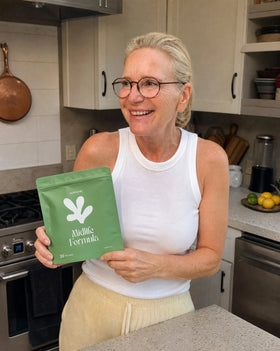
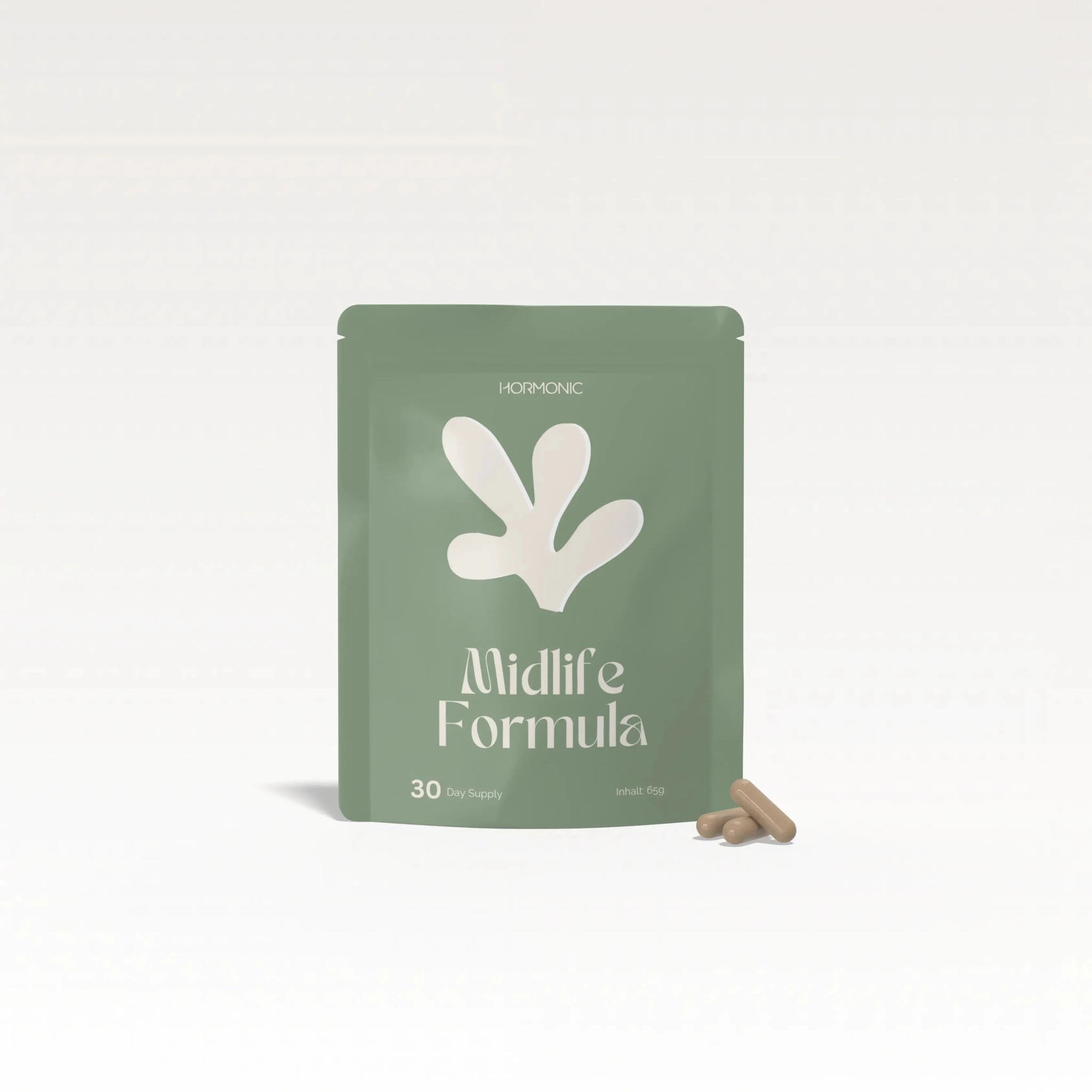
Red Clover Isoflavones, clearly declared: Midlife Formula
The Midlife Formula provides 40 mg of red clover isoflavones per daily dose, an amount within the range studied for menopausal symptoms and in line with BfR guidelines. It is supplemented by eight additional active ingredients, such as saffron, wild yam, and creatine. Developed by doctors and manufactured in Austria.
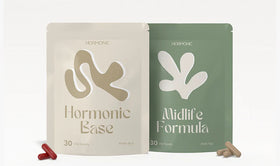
For bones and energy: the Midlife Bundle
As estrogen levels drop, so does the protection for your bones. In the Midlife Bundle, the Hormonic Base complements the Midlife Formula with 16 micronutrients, including vitamin D, which contributes to the maintenance of normal bones, and magnesium, which contributes to the reduction of tiredness and fatigue. 25 active ingredients in one routine, with a price advantage compared to purchasing individually.
Frequently asked questions about red clover during menopause
Why is red clover not recommended during menopause?
What are the effects of red clover on women?
Welches ist das beste pflanzliche Mittel in den Wechseljahren?
Wie viel Rotklee pro Tag in den Wechseljahren?
Scientific Sources
- Kanadys W, Barańska A, Błaszczuk A et al. (2021). Evaluation of Clinical Meaningfulness of Red Clover (Trifolium pratense L.) Extract to Relieve Hot Flushes and Menopausal Symptoms in Peri- and Post-Menopausal Women: A Systematic Review and Meta-Analysis of Randomized Controlled Trials. Nutrients 13(4):1258. doi:10.3390/nu13041258
- Myers SP, Vigar V (2017). Effects of a standardised extract of Trifolium pratense (Promensil) at a dosage of 80 mg in the treatment of menopausal hot flushes: a systematic review and meta-analysis. Phytomedicine 24:141-147. doi:10.1016/j.phymed.2016.12.003
- Ghazanfarpour M, Sadeghi R, Roudsari RL et al. (2016). Red clover for treatment of hot flashes and menopausal symptoms: a systematic review and meta-analysis. J Obstet Gynaecol 36(3):301-311. doi:10.3109/01443615.2015.1049249
- Lethaby A, Marjoribanks J, Kronenberg F et al. (2013). Phytoestrogens for menopausal vasomotor symptoms. Cochrane Database Syst Rev. doi:10.1002/14651858.CD001395.pub4
- Tice JA, Ettinger B, Ensrud K et al. (2003). Phytoestrogen supplements for the treatment of hot flashes: the Isoflavone Clover Extract (ICE) study. JAMA 290(2):207-214. doi:10.1001/jama.290.2.207
- Geller SE, Shulman LP, van Breemen RB et al. (2009). Safety and efficacy of black cohosh and red clover for the management of vasomotor symptoms: a randomized controlled trial. Menopause 16(6):1156-1166. doi:10.1097/gme.0b013e3181ace49b
- Lambert MNT, Thorup AC, Hansen ESS, Jeppesen PB (2017). Combined Red Clover isoflavones and probiotics potently reduce menopausal vasomotor symptoms. PLoS One 12(6):e0176590. doi:10.1371/journal.pone.0176590
- Lambert MNT, Thybo CB, Lykkeboe S et al. (2017). Combined bioavailable isoflavones and probiotics improve bone status and estrogen metabolism in postmenopausal osteopenic women: a randomized controlled trial. Am J Clin Nutr 106(3):909-920. doi:10.3945/ajcn.117.153353
- Thorup AC, Lambert MN, Kahr HS et al. (2015). Intake of novel red clover supplementation for 12 weeks improves bone status in healthy menopausal women. Evid Based Complement Alternat Med 2015:689138. doi:10.1155/2015/689138
- Luís Â, Domingues F, Pereira L (2018). Effects of red clover on perimenopausal and postmenopausal women's blood lipid profile: a meta-analysis. Climacteric 21(5):446-453. doi:10.1080/13697137.2018.1501673
- Atkinson C, Warren RML, Sala E et al. (2004). Red-clover-derived isoflavones and mammographic breast density: a double-blind, randomized, placebo-controlled trial. Breast Cancer Res 6(3):R170-179. doi:10.1186/bcr773
- Lipovac M, Chedraui P, Gruenhut C et al. (2010). Improvement of postmenopausal depressive and anxiety symptoms after treatment with isoflavones derived from red clover extracts. Maturitas 65(3):258-261. doi:10.1016/j.maturitas.2009.10.014
- Magee PJ (2011). Is equol production beneficial to health? Proc Nutr Soc 70(1):10-18. doi:10.1017/S0029665110003940
- EFSA ANS Panel (2015). Risk assessment for peri- and post-menopausal women taking food supplements containing isolated isoflavones. EFSA Journal 13(10):4246. doi:10.2903/j.efsa.2015.4246
- BfR (2015). Dietary supplements with isolated isoflavones: orientation values for dosage and duration of use. Communication No. 043/2015 of 16.11.2015.
- DGGG, SGGG, OEGGG (2026). S3 Guideline Peri- and Postmenopause: Diagnostics and Interventions. AWMF Registry Number 015-062, consultation draft.
- The North American Menopause Society (2023). The 2023 nonhormone therapy position statement. Menopause 30(6):573-590. doi:10.1097/GME.0000000000002200
- Muntean E, Urda C (2020). Isoflavones in red clover tea infusions. Proceedings of the 6th International Electronic Conference on Medicinal Chemistry. doi:10.3390/ECMC2020-07251
About the Author

You might also be interested in this.
The yam root is more exciting than its reputation as "natural progesterone" would suggest. What studies on menopausal symptoms, inflammation, muscles, the brain, and metabolism show, and what you s...

Hot flashes during and before menopause: What happens hormonally, which measures truly help, and when other causes should be investigated.
What helps with hot flashes, mood swings, or trouble sleeping? Studies show these plant-based compounds can support you through menopause.